
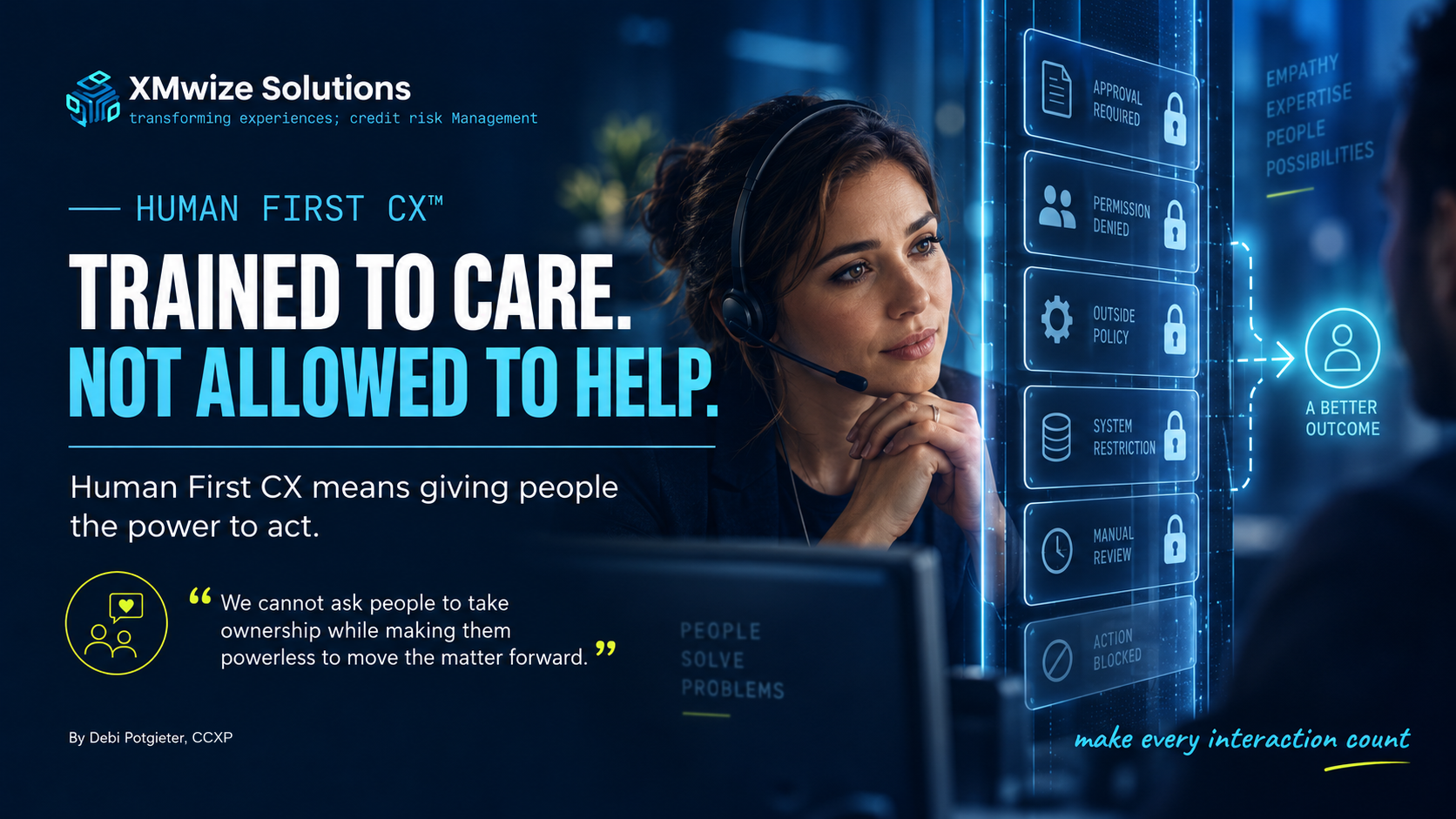
Human First CX means giving people the power to act.
You have explained your problem to a chatbot, followed the prompts and waited in a queue. Finally, a person answers. They listen, understand and agree that something needs to be done.
“I would love to help, but the system will not let me.”
You have reached someone who cares. You are still waiting for someone who can act.
In my CICM article, The Customer Did Not Enter an Escape Room, I challenged journeys that make customers fight to reach a person. But opening that door is only part of the work. Can the person on the other side see the information, make a decision or reach someone who can?
We cannot ask people to take ownership while making them powerless to move the matter forward.
A July 2025 case published by South Africa’s National Financial Ombud concerned a customer disputing a R5,000 clothing-account transaction. He had neither an email address nor a smartphone, which limited his ability to participate in the investigation. After considering his circumstances and payment history, the Ombud recommended a goodwill refund. The credit provider agreed, also refunding R1,290 in interest.
The case does not establish what authority employees had. It shows why customers need a practical alternative when they cannot use standard channels. Clearer email instructions would not have given this customer an email address.
Someone needed the ability to consider another route.
Consider an employee who can see an incorrect charge but cannot correct it. They send a request to another team. The customer calls again. Another employee sends another request. Everyone follows the procedure. The customer is still waiting.
Sending that employee on another empathy course will not clear the approval queue. Learning matters, but skills need to be matched by information, authority and support. Otherwise, we risk training people to deliver a more polished apology for a problem they cannot resolve.
Authority needs boundaries. Some requests should be declined; others need specialist review. Employees should know what they can decide, who approves exceptions and how quickly. Every referral needs an owner and a response time. Sound judgement also needs leadership support.
Empathy needs somewhere to go: an action, a decision or a clear next step that someone owns.
A 2025 study in The Quarterly Journal of Economics examined an AI assistant used by 5,172 customer-support agents. Issues resolved per hour increased by 15% on average, with less experienced and lower-skilled employees benefiting most. Employees could edit or ignore the suggestions. The most experienced and highest-skilled agents saw small gains in speed but small declines in quality.
Use AI to make knowledge easier to reach, reduce administration and support decisions. Then follow the task through. Can the employee act? Can an authorised digital process complete the request safely? Who takes responsibility for an exception?
A faster answer is valuable. A faster route to an appropriate outcome is better.
GSMA’s analysis of the World Bank’s Global Findex 2025 data found that 40% of adults in Sub-Saharan Africa owned a mobile money account in 2024. The region remained the global leader in mobile money account ownership.
Our opportunity is to build on digital adoption while designing properly for the moments when help is needed. What happens when a payment cannot be traced, an account problem interrupts trading or a customer struggles with the language or device?
Test these questions in each market, with the people using the service. One country’s experience cannot stand in for a continent.
Alongside every digital service, test the support behind it. Can employees access the information? Do local teams have enough authority? Can customers get a fair decision without being sent from one place to another?
When a customer says, “Nobody could help me,” ask what stopped progress. Was information missing? Did systems disagree? Was approval out of reach?
This is the CX before CX™: the decisions made before the conversation that shape what becomes possible during it.
Start with five unresolved cases. Work through them with the employees involved. Find where progress stopped and who can unblock it. Keep necessary controls, but review rules that create avoidable difficulty. Give each improvement an owner.
Measure the whole case: waiting time, repeat contacts, missed commitments and whether the agreed action happened.
Then ask: “What do you need from us to help this customer properly?” Be prepared for the answer to require a leadership decision.
Customers should not have to understand our reporting lines, chase our approvals or persuade departments to speak to one another.
Before the next training programme, check that people can apply what they learn. Before the next technology launch, ask what it will help them resolve. Before asking for more ownership, check whether anyone has the authority to act.
XMbyte™ is XMwize Solutions’ Human First learning and performance companion, delivered through WhatsApp. It combines short learning bites, practical guidance, reinforcement and checks to help employees apply what they know with greater confidence, while giving leaders a clearer view of where support is needed.
Pair that support with clear authority, workable processes and leadership backing, so people can turn learning into action.
Speak to XMwize Solutions about how XMbyte™ can support and empower your team: connect@xmwize.co.za.
Train people to care. Give them the power to help.
Make every interaction count.
CEM Africa connects CX industry professionals and organisations to information and each other in a carefully curated live and online environment. It's purpose, to help shape the future of CX in Africa.
Exhibit or Sponsor CEM Africa
Attend CEM Africa
For other enquiries contact:
T: +27 21 700 3500
+27 21 700 3512


.webp)

.webp)
.webp)
.webp)
