
At Water Security Africa, one of the most practical sessions of the summit moved beyond theory and into implementation.
Rather than debating what should happen, utility leaders from Uganda, Kenya and South Africa shared real-world projects, lessons learned and honest reflections on what has worked and what hasn’t.
The result was a valuable exchange between utilities facing many of the same pressures: ageing infrastructure, rising demand, climate uncertainty, funding constraints and increasing expectations to improve service delivery.
Despite the different operating environments, one message emerged consistently:
Africa already has the knowledge and practical experience needed to improve water security. The challenge now is scaling successful approaches faster.
Opening the session, moderator Zakhele Mayisa, Senior Consultant, Private Sector Engagement and Business Development, Water Security and Sanitation Division, African Development Bank, challenged delegates to focus on implementation rather than aspiration.
Instead of discussing future possibilities, presenters demonstrated projects already delivering measurable outcomes in their respective countries from reducing non-revenue water and modernising customer management to developing new financing models and improving infrastructure planning.
The session highlighted an important shift taking place across the continent:
Water security is increasingly becoming an operational challenge that requires practical engineering, digital innovation, financial sustainability and institutional collaboration working together.
Uganda’s presentation delivered by Gilbert Muhwezi, Senior Manager: Non-Revenue Water Management, Kampala, NWSC Uganda, demonstrated how infrastructure projects cannot be viewed in isolation.
While significant investment had expanded treatment capacity, speakers explained that distribution networks had not been upgraded at the same pace. The result was a familiar challenge across many African cities:
The case study highlighted that funding gaps and phased project implementation can unintentionally delay the full benefits of major infrastructure investments.
One of the strongest messages from Uganda was that water infrastructure should be planned as an integrated system, rather than a series of disconnected projects.
The utility also showcased initiatives aimed at improving access for underserved communities through public standpipes and customer-focused service models, demonstrating that infrastructure investment and social inclusion must progress together.
Kenya’s presentation delivered by Ephantus Mugo, Project Manager, Nairobi City Water and Sewerage Company focused on one of the continent’s most pressing operational challenges Non-revenue water (NRW).
The utility shared that although additional bulk water had significantly increased available supply, the extra pressure within ageing distribution networks also exposed previously hidden leaks.
Rather than viewing this as failure, the utility used the experience to strengthen its NRW strategy.
Key initiatives include:
One particularly valuable insight challenged a common misconception:
Non-revenue water does not simply represent water lost through leaks. It also includes inaccurate metering, unauthorised consumption, billing inefficiencies and operational losses.
The presentation reinforced that digital technologies alone are not the solution but when combined with operational reform and accurate data, they become powerful tools for improving utility performance.
Nairobi City Water and Sewerage Company also shared its evolving approach to public-private partnerships (PPPs).
While many discussions around PPPs focus primarily on attracting private investment, the presentation highlighted the institutional work required before partnerships can succeed.
This includes:
One particularly important observation was that successful PPP implementation depends as much on organisational culture as financial investment.
South Africa’s presentation by Emmanuel Khomela, Executive Manager: Infrastructure Planning & Projects, ERWAT, painted a sobering picture of the country’s current water losses.
Provincial comparisons showed that many municipalities continue to experience water losses well above accepted performance benchmarks.
However, the session also highlighted encouraging examples of municipalities achieving significantly better outcomes.
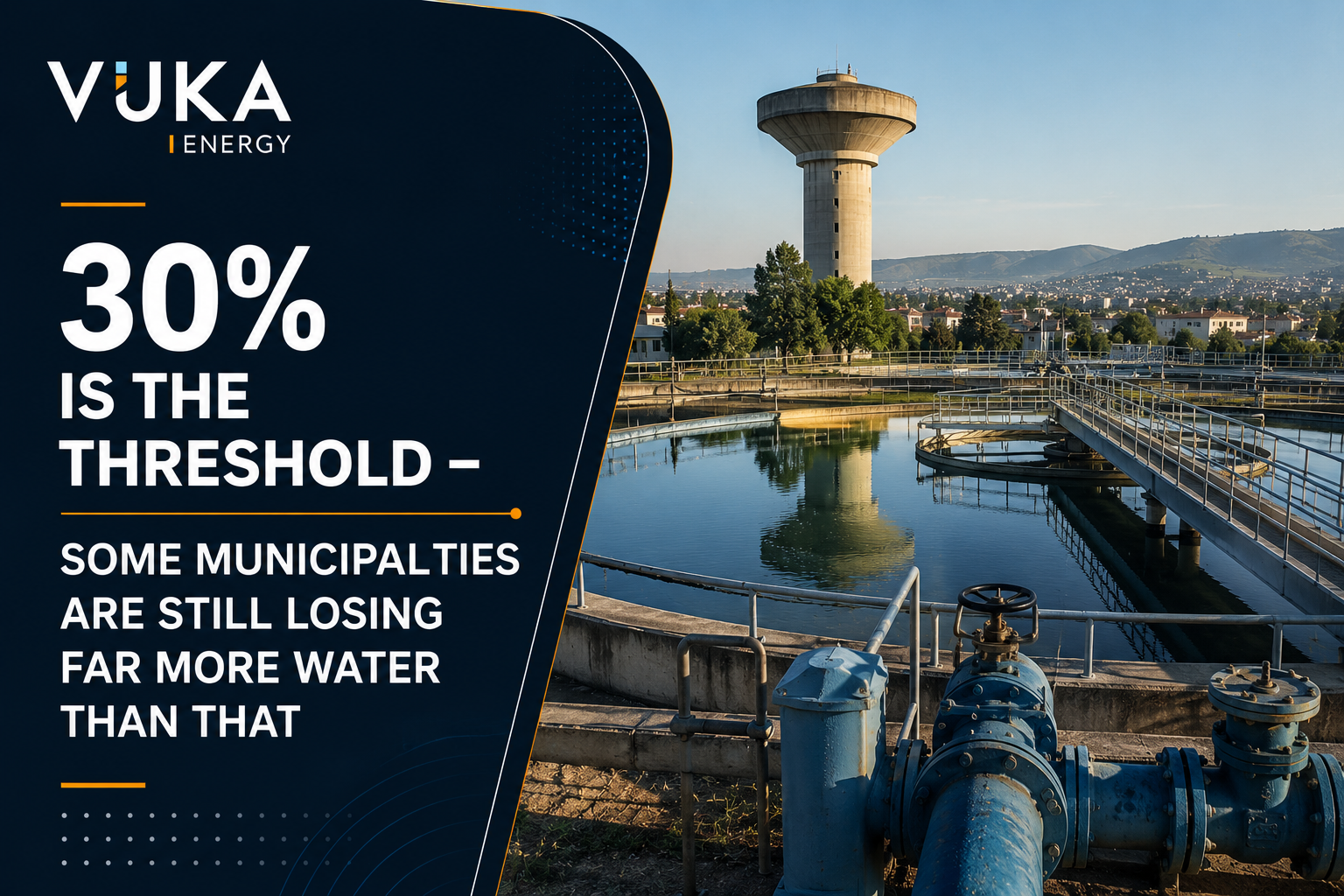
Cape Town was recognised for maintaining water losses below the commonly referenced 30% threshold, demonstrating that sustained investment, operational discipline and proactive asset management can produce measurable improvements.
The discussion reinforced several priorities for South African utilities:
Rather than presenting NRW as purely a technical issue, speakers emphasised its direct impact on financial sustainability, water security and future economic growth.
Although each country presented different experiences, several common themes emerged.
Building treatment plants without upgrading distribution systems limits long-term impact. Utilities increasingly need integrated planning across the entire water value chain.
Smart meters, digital monitoring, data analytics and improved customer information systems are no longer optional technologies.
They are becoming fundamental tools for:
Utilities repeatedly stressed that funding should support complete project implementation rather than isolated infrastructure components.
Better alignment between financing, planning and delivery is essential for maximising project outcomes.
Technology and infrastructure alone cannot transform water utilities.
Success depends equally on:
Perhaps the strongest message from the session was that African utilities have much to learn from one another.
Rather than importing solutions from elsewhere, many of the continent’s most valuable innovations are already being developed locally.
Knowledge sharing between utilities is becoming one of the fastest ways to improve performance.
The session demonstrated that Africa’s water sector is no longer short of ideas.
Across Uganda, Kenya and South Africa, utilities are already implementing digital technologies, strengthening operational performance, exploring innovative financing models and improving customer service.
While challenges remain significant including ageing infrastructure, climate pressures and constrained funding, the presentations showed that practical, scalable solutions are already emerging.
The next phase of Africa’s water journey will depend less on identifying the right solutions and more on replicating proven approaches, building institutional capacity and strengthening collaboration across the continent.
As delegates left the session, one conclusion stood out clearly:
Africa’s water security future will be shaped not only by new investment, but by how effectively utilities learn from one another and turn proven experience into widespread implementation.
READ NEXT: Beyond infrastructure – 5 lessons from African utilities building water resilience

 Contact Us
VUKA is the trusted media partner to key professionals, policy makers, suppliers and
manufacturers. We provide unparalleled opportunities for industry-wide connection.
