One of the defining discussions at Water Security Africa explored one of the sector’s most pressing questions: how can Africa mobilise the finance needed to build water resilience at scale?
While billions of dollars are available globally for climate finance, panellists argued that water continues to receive only a fraction of the investment required because projects are still perceived as difficult to finance rather than impossible to deliver.
Moderated by Zaid Railoun, Specialist: Power & Sustainable Solutions, Standard Bank Business & Commercial Banking, the discussion brought together senior representatives Joel Buatre, Head: Emerging Sectors, Business Ecosystems & Sustainability, Standard Bank , Bothwell Manikai, Head: Coverage – Transport, Logistics & Bulk Water; and Principal – Infrastructure Financing, South Africa & International, Investment Division, Development Bank of Southern Africa (DBSA) and Zakhele Mayisa, Senior Consultant, Private Sector Engagement and Business Development, Water Security and Sanitation Division, African Development Bank (AFDB) to unpack why the financing gap persists and what needs to change.
The discussion began by reframing water as one of the world’s most important climate adaptation priorities.
Unlike renewable energy projects, which generate clear revenue streams through electricity sales, water resilience investments often generate value through avoided losses, operational continuity and economic stability rather than direct income.
This makes traditional project finance models difficult to apply.
The panel argued that businesses increasingly understand water as a strategic risk affecting production, supply chains and business continuity, yet financial markets are still catching up in recognising this broader value proposition.
Financing frameworks therefore need to evolve beyond conventional infrastructure lending towards resilience-based investment models.
A recurring theme throughout the discussion was that capital is available, but bankable projects remain scarce.
Zakhele from the African Development Bank highlighted what they described as a “perceived bankability deficit” across the water sector. While many projects are technically viable, several structural barriers continue to discourage investment, including:
Without these fundamentals in place, financiers struggle to assess risk confidently, regardless of available funding.
Bothwell from the DBSA emphasised that financing does not start when construction begins, it starts years earlier.
Rather than acting purely as a lender, the bank described its role as an integrated development partner that works alongside municipalities throughout the project lifecycle, including:
This upstream support was identified as essential to transforming infrastructure concepts into investment-ready projects capable of attracting both development finance and commercial capital.
ALSO READ: How AI and data centres can boost South Africa’s capability for renewable projects
Across all three financial institutions there was strong consensus that blended finance will become the dominant funding model for future water infrastructure.
Development finance institutions are better positioned to absorb early-stage project risks through concessional finance, guarantees and first-loss capital, while commercial banks can participate once projects become financially mature.
The discussion highlighted several mechanisms that can bridge this financing gap, including:
Rather than expecting one institution to finance an entire project, panellists advocated for collaborative capital stacks where each organisation finances the risks it is best equipped to manage.
South Africa’s deteriorating municipal infrastructure featured prominently throughout the discussion.
The DBSA noted that while considerable attention is given to developing new infrastructure, insufficient investment is directed towards maintaining existing assets. Long-term operational sustainability must become a financing priority rather than an afterthought.
The panel stressed that municipalities require more than funding, they need technical capacity, planning support, engineering expertise and operational capability to ensure assets continue delivering value throughout their lifecycle.
One of the strongest moments came during audience discussion, where Benoît Le Roy from the South African Water Chamber challenged the panel on South Africa’s worsening non-revenue water crisis.
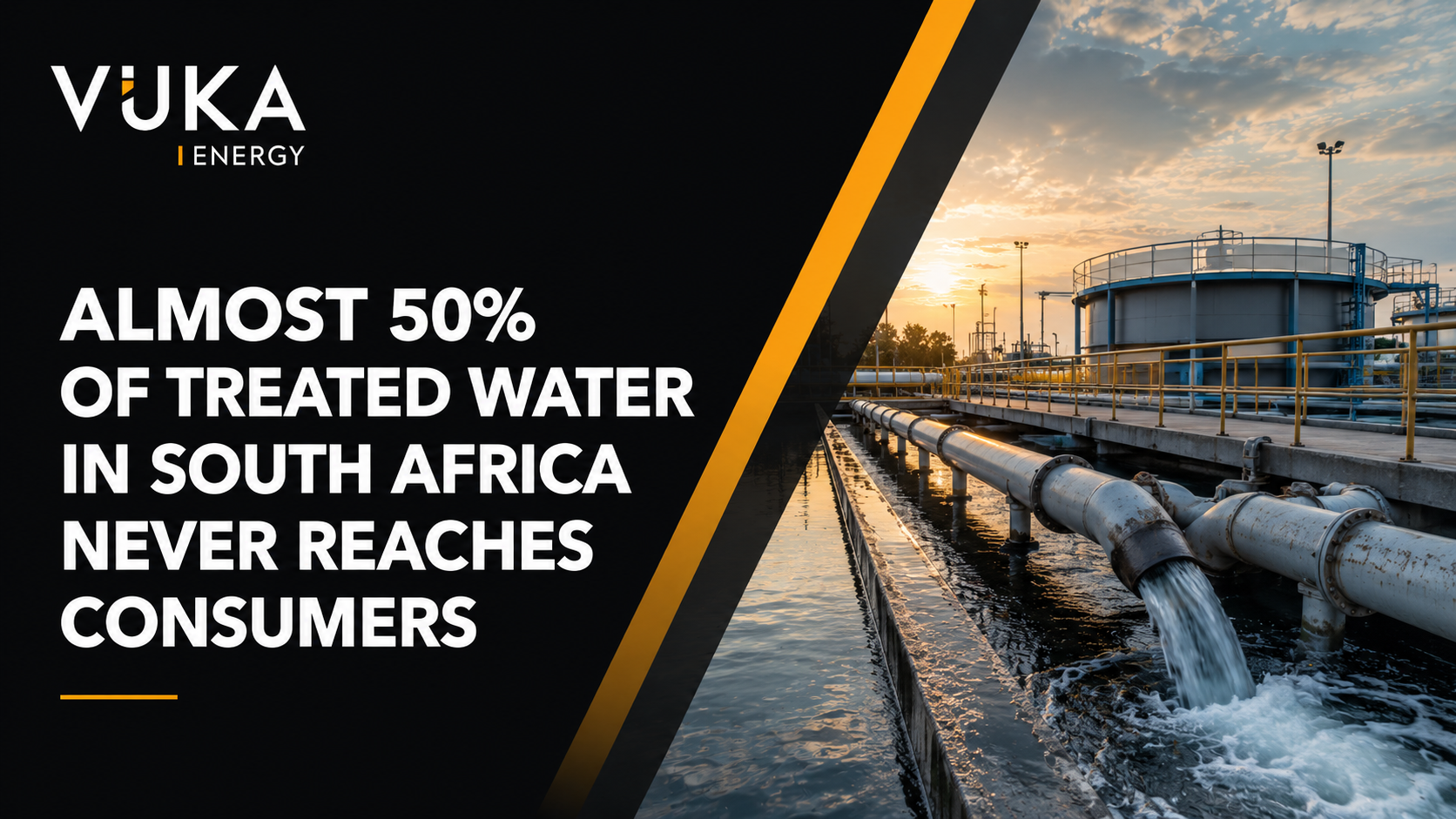
He highlighted that nearly half of treated water is currently lost before reaching consumers, arguing that investment in downstream water reuse alone cannot solve the country’s water security challenge while distribution networks continue to leak at scale.
The discussion reinforced that reducing non-revenue water represents one of the fastest and most bankable opportunities to improve national water security, but delivering projects will require stronger public-private partnerships and blended finance structures capable of addressing municipal risk.
The panel also explored how commercial and industrial users are increasingly investing directly in their own water security.
Rather than relying solely on municipal supply, businesses are deploying technologies such as:
Commercial banks are beginning to develop financing products that reward these investments through sustainability-linked finance and outcome-based lending linked to measurable water resilience outcomes.
The African Development Bank outlined several financing instruments available to accelerate water investment across Africa.
These include:
Municipalities, utilities and project developers are encouraged to engage earlier in the project lifecycle to access preparation funding before seeking construction finance.
The discussion concluded that Africa’s water financing challenge is no longer simply about finding more money it is about creating more investment-ready projects.
Speakers agreed that achieving water resilience will depend on strengthening project preparation, improving municipal capacity, expanding blended finance models and recognising water as a strategic economic asset rather than solely a public service.
Greater collaboration between governments, development finance institutions, commercial banks and the private sector will be essential to unlocking the scale of investment needed to build resilient water systems across the continent.
This session positioned finance not as a barrier, but as a catalyst for accelerating Africa’s transition from water risk to long-term water resilience.
WEBINAR: Webinar: Balancing the scales – climate change, energy security and Africa’s optimal energy mix
 Contact Us
VUKA is the trusted media partner to key professionals, policy makers, suppliers and
manufacturers. We provide unparalleled opportunities for industry-wide connection.