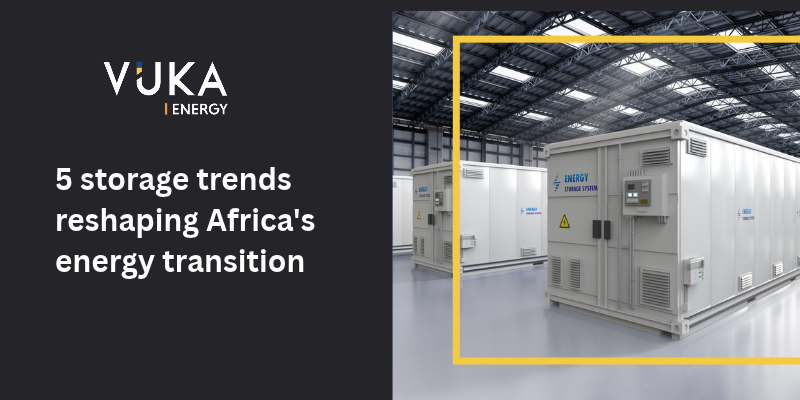
The rapid expansion of renewable energy across Africa is fundamentally changing the role of energy storage.
Once viewed primarily as backup power during outages, storage is increasingly being recognised as a critical enabler of reliable, flexible and resilient electricity systems.
That was the central theme of the Innovate Stage session Renewable Integration at Enlit Africa on 19 May, where industry leaders from utilities, municipalities, technology providers, finance and system operations explored how storage technologies must evolve alongside Africa’s changing electricity landscape.
Moderated by Isabel Fick, Group Head of Trading and Operations at Africa GreenCo, the discussion moved beyond batteries alone to examine long-duration storage, pumped hydro, ancillary services, policy reform and Africa’s opportunity to build its own battery value chain.
Opening the session, Fick explained that energy storage has become essential to operating increasingly renewable electricity systems.
Speaking from both her experience as Eskom’s former System Operator and her current role at Africa GreenCo, she highlighted the need for flexibility across future African grids “We need various forms of storage as well as flexibility to stabilise any electrical transmission network in the world.”
She argued that storage should not be viewed in isolation, noting that policy, market reform and regional electricity trading will ultimately determine how successfully new technologies are deployed.
“Storage is not an isolated technology discussion. It is also a discussion around where’s the will and how are we going to make this happen with the correct policies in place.”
From a commercial and industrial perspective, Maudene van Rooyen of Standard Bank described how customer priorities have evolved dramatically over the past few years.
During the height of South Africa’s loadshedding, businesses invested in battery systems simply to survive prolonged outages.
Today, as grid performance has improved, investment decisions are driven by a broader combination of energy security, operating costs, power quality and sustainability.
Van Rooyen explained: “They’re not looking at battery energy storage as a backup anymore, it’s more energy security.”
She added that successful projects increasingly depend on integrating battery storage within a broader energy strategy that includes generation, energy efficiency and sound financial structuring rather than viewing batteries as standalone investments.
CASE STUDY: Mossel Bay’s wastewater plant shows how microgrids can strengthen municipal resilience
Raj Pandaram from the National Transmission Company South Africa (NTCSA) outlined the growing importance of ancillary services as South Africa transitions towards a more decentralised electricity system.
He explained that increasing volumes of variable renewable generation, together with the emergence of large new electricity users such as data centres, will significantly increase demand for services including frequency regulation, reserves, voltage control, system restoration and grid stability.
“We’re going into this change transition from large power stations to distributed energy,” he said, noting that many more ancillary services would be required to operate the future grid.
Importantly, Pandaram stressed that the system operator remains technology neutral. “We are technology agnostic, so we can get the services from any technologies if those services are available.”
One of the session’s strongest debates centred on whether lithium-ion batteries have unintentionally overshadowed other storage technologies that may be better suited to supporting future electricity systems.
Tom Gebauer, CEO of Redox One, acknowledged the success of lithium-ion technology while arguing that different applications require different solutions. “Lithium-ion batteries, they can’t serve every application.”
Gebauer emphasised that while lithium-ion batteries have successfully established the short-duration storage market, policymakers, regulators and investors must also begin supporting technologies capable of delivering longer-duration storage.
He argued that investment decisions should be based on market needs rather than simply following today’s dominant technology. “Everything that’s being developed needs to serve a purpose.”
The discussion also highlighted the different business models associated with long-duration storage, where value may be created over decades rather than through high daily cycling.
Despite growing interest in battery technologies, panellists repeatedly highlighted the continued importance of pumped hydro storage.
Pandaram described pumped hydro as proven, reliable technology capable of delivering the full range of ancillary services required by system operators. “From a system operator point of view, pump storage is very reliable. It’s proven technology.”
However, speakers acknowledged that geographical constraints, long construction timelines and water availability remain important considerations for future projects.
Marlyn Hendriks from the City of Cape Town suggested that attention should also be given to newer gravity-based storage concepts alongside traditional pumped hydro designs.
From the banking perspective, Van Rooyen argued that financing decisions are ultimately driven by project economics rather than technology preferences.
She explained that financiers focus on payback periods, cash flow and ensuring projects strengthen rather than weaken a client’s financial position.
The discussion also explored hydropower, where she suggested higher upfront costs can often be offset by long asset lifetimes, lower maintenance requirements and the ability to provide dependable baseload power.
She noted that, under the right conditions, hydro projects can outperform more conventional battery and solar combinations over the long term.
The environmental implications of battery manufacturing and recycling also featured prominently.
Huawei’s Muhammed Ismail Seedat acknowledged that while lithium-ion battery performance has improved significantly over recent years, the industry is still developing large-scale recycling capability.
“We don’t really have many projects out there which have actually gone through the full life cycle to actually see how successful these recycling programmes have been.
“He noted that recycling technologies are advancing, with new companies preparing for the growing number of batteries expected to reach end-of-life over the coming decades.
The conversation concluded by examining Africa’s role within the global battery supply chain.
While the continent possesses significant reserves of lithium, cobalt, graphite and manganese, panellists questioned whether African countries are capturing sufficient value from these resources.
Hendricks argued that stronger industrial policies could help African countries move beyond raw mineral exports into processing and manufacturing.
However, he cautioned that policy alone would not be enough. Reliable electricity, supporting infrastructure, skilled workers and investment would all be required to establish a competitive battery manufacturing industry.
Closing the session, Fick reflected that no single storage technology will solve Africa’s energy transition.
Instead, success will depend on combining different technologies with market reform, investment, policy development and new trading mechanisms that reward flexibility.
“We first need to solve the storage problem, we need to solve the TDP, we need to solve the IRP, we need to solve all the policy issues,” she concluded, encouraging the industry to work collectively towards a more resilient African power system.
READ NEXT: Africa’s Water security challenge – why collaboration is the missing link

 Contact Us
VUKA is the trusted media partner to key professionals, policy makers, suppliers and
manufacturers. We provide unparalleled opportunities for industry-wide connection.