
There is a statistic that stops most business leaders in their tracks. High-trust nations outperform low-trust ones by over a thousand percent. High-trust organisations outperform their counterparts by up to four hundred percent. And yet, in boardrooms across Africa, trust is still treated as a communications problem rather than a business imperative.
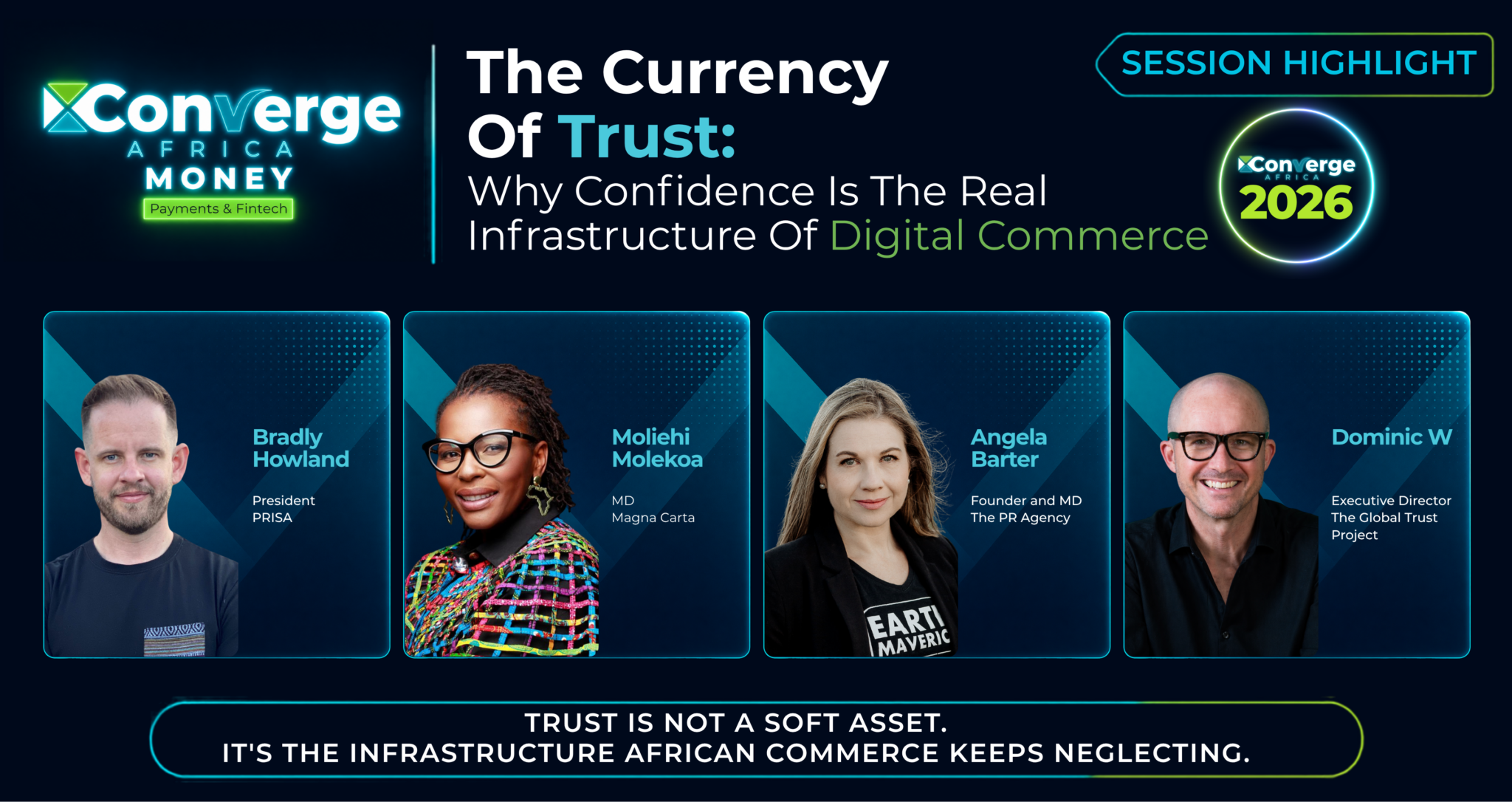
At Converge Africa 2026, a panel of communications, PR and trust specialists gathered to challenge that framing. Moderated by Bradley Howland, president of the Public Relations Institute of Southern Africa, the discussion featured Dominic Wilhelm, executive director of the Global Trust Project, Moliehi Molekoa, managing director of Magna Carta, and Angela Barter, founder and managing director of a sustainability-focused communications agency.
The conclusion was sharp: trust is not something you build in a campaign. It is something you earn, or forfeit, in every single interaction your customer has with your brand.
Dominic Wilhelm opened with a challenge that set the tone for the entire conversation:
“We have an instinct to undervalue what compounds over time and collapses catastrophically.” — Dominic Wilhelm, Global Trust Project
It is a precise description of how most organisations treat trust. The value builds invisibly across months and years of consistent behaviour. The collapse, when it comes, is sudden, visible, and largely beyond the reach of any communications response.
The data makes this concrete. Where once three touchpoints were enough to move a consumer toward engagement with a brand, that number now exceeds twenty. Each of those interactions is either adding to a reserve of trust or quietly drawing it down. Most brands are not tracking which.
Wilhelm traced the framework back 175,000 years, arguing that human beings have always evaluated whether to extend trust based on three consistent criteria: integrity (do their words match their actions?), benevolence (is this relationship genuinely reciprocal?), and capability (can they actually deliver what they promise?).
These are not abstract principles. They are the practical architecture on which every commerce relationship is built. When all three are present, trust emerges naturally. When one is absent, it does not.
Angela Barter drew a direct line from those pillars to sustainability communication: benevolence becomes transparency, integrity becomes substantiation, and capability becomes action. Her practical test for brands was direct:
“If you can’t prove it, you shouldn’t be saying it.” — Angela Barter
One of the panel’s more uncomfortable observations came from Moliehi Molekoa: trust is almost universally relegated to the communications department, rather than owned at board level.
The consequence is a structural misalignment. Large budgets flow towards campaigns that tell audiences how good a brand is. Comparatively little attention goes to the frontline interactions — the call centre agent, the chatbot, the fine print in the contract — that determine whether that promise holds.
“From the CEO right up to the cleaner, they need to make sure that they live the brand. It cannot just be a one-person job.” — Moliehi Molekoa, Magna Carta
The ask is not simply for better communications. It is for trust to be treated as an organisational discipline, one that every function is accountable for and every leader models daily.
The panel brought the abstract into sharp focus through two examples.
Angela Barter cited the Volkswagen emissions scandal, where the company settled billions in penalties after a cheat device was discovered in its ‘clean diesel’ vehicles. Beyond the financial and reputational damage, Barter pointed to a less-discussed consequence: the campaign distorted consumer decision-making and, once the device switched off in real-world conditions, emissions increased. The brand had not just damaged itself. It had undermined genuine environmental progress.
Moliehi Molekoa referenced a closer-to-home case, involving a well-known South African brand that faced near-liquidation after misrepresenting its financial performance. The misalignment between what was reported and what was real had eroded, in months, the trust that took over a hundred years to build.
The pattern in both cases was identical: a gap between promise and reality, unaddressed for too long, until it became a collapse.
As artificial intelligence becomes a default content tool for many brands, the panel flagged an emerging risk: consumers are subconsciously disengaging the moment they recognise content as AI-generated. This is happening at a neurological level, before any conscious evaluation takes place.
For brands under budget pressure, the temptation to use AI as the default for content and communication is significant. But the unintended consequence — reduced engagement, reduced trust — is rarely being measured.
Wilhelm’s position was unambiguous: the accountability for AI outputs has never left the humans who built the systems and set the policy. ‘There is no thing that is made that is not made by a person.’ The practical implication is that AI adoption without corresponding investment in integrity and oversight does not save trust. It drains it.
The conversations at Converge Africa 2026 made one thing clear: the brands that will lead in African commerce are not necessarily the ones with the biggest budgets or the most advanced technology. They are the ones that have made trustworthiness a non-negotiable operational standard, not a campaign theme. As the digital commerce landscape continues to evolve, the window to build that foundation is now, not after the collapse.
Converge Africa is a part of a series of retail events unlike any other. It's the new unifying brand for the digital commerce value chain. Formerly ECOM Africa.
Converge Africa Conference & Expo
For enquiries contact:
T: +27 21 700 3500
T: +27 21 700 3579


.webp)

.webp)
.webp)
.webp)
