
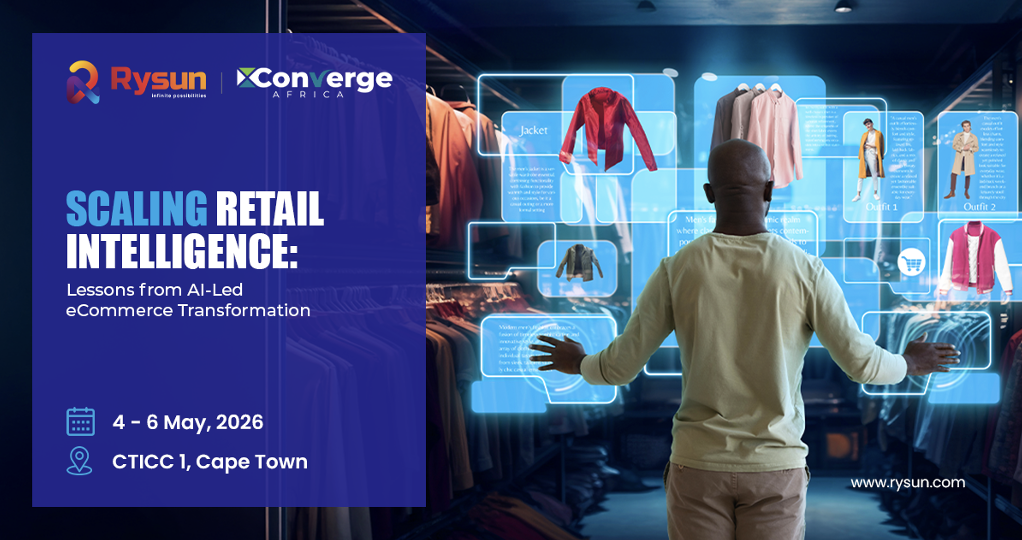
As retail and eCommerce organizations continue to grow and expand their digital presence, the complexity of their operations increases at a rapid pace. A broader product portfolio, the proliferation of channels, and a growing number of customer touchpoints all contribute to a more demanding and dynamic operating environment.
In this context, the key question facing business leaders is no longer whether to adopt AI, but how to scale it effectively in a way that delivers measurable and sustained impact.
Insights drawn from transformation journeys across the industry suggest that success is rarely driven by isolated AI initiatives. Instead, it comes from embedding intelligence across the entire commerce ecosystem in a way that aligns with broader business objectives.
Many retail organizations begin their transformation journey with a fragmented foundation, characterized by disconnected commerce platforms, limited visibility into customer behaviour, and a heavy reliance on manual processes across merchandising and inventory management.
These limitations often result in inefficiencies that manifest as stock imbalances, inconsistent customer experiences, and missed revenue opportunities, all of which can hinder growth and competitiveness.
Leading organizations are increasingly moving beyond standalone AI deployments and are instead integrating intelligence directly into their core operations, ensuring that it becomes part of how the business functions on a day-to-day basis.
AI-driven insights enable retailers to refine product assortments by identifying high-performing SKUs and adjusting offerings in line with evolving demand patterns. This leads to more relevant product availability and a stronger alignment between supply and customer expectations.
Improved forecasting capabilities allow organizations to plan inventory with greater precision, reducing waste and lowering holding costs while also ensuring that products are available when and where they are needed. This is particularly important in environments where supply chain inefficiencies can have a direct impact on customer satisfaction.
AI enhances the customer journey across every stage, from discovery and evaluation to post-purchase engagement. Recommendations become more relevant, content becomes more contextual, and communication becomes more timely, resulting in a more cohesive and engaging overall experience.
When AI is integrated effectively across the value chain, the impact is both tangible and measurable. Organizations that successfully integrate AI across their operations typically achieve:
These outcomes reinforce the idea that AI should not be viewed simply as a technological enhancement, but rather as a core driver of business performance.
A single source of truth is essential for accurate insights and effective AI models.
Cloud-based, modular systems enable rapid experimentation and deployment.
AI initiatives must align with business objectives across marketing, operations, and IT.
AI systems improve over time, requiring ongoing monitoring and refinement.
Despite the clear benefits, many organizations encounter challenges when attempting to scale AI, often due to an over-reliance on fragmented tools, a lack of clear prioritization of use cases, or an underestimation of the importance of data readiness.
Organizations that are able to overcome these challenges typically take a more holistic and strategy-led approach, focusing on long-term value creation rather than short-term implementation.
Looking ahead, the next phase of retail evolution is moving toward what can be described as autonomous commerce, where AI systems go beyond providing insights and begin to take action in real time.
This includes dynamically adjusting pricing, enabling supply chains to respond automatically to changing conditions, and continuously refining customer experiences based on behavioural signals. Over time, this creates systems that are increasingly self-learning and self-optimizing.
Scaling AI in retail and eCommerce is not simply about introducing new tools or technologies, but about fundamentally rethinking how commerce operates across the organization.
Businesses that successfully embed intelligence across their value chain will be better equipped to manage complexity, respond to change with agility, and sustain long-term growth.
In an increasingly competitive and fast-moving landscape, intelligence is rapidly becoming a foundational capability rather than a differentiator.
Converge Africa is a part of a series of retail events unlike any other. It's the new unifying brand for the digital commerce value chain. Formerly ECOM Africa.
Converge Africa Conference & Expo
For enquiries contact:
T: +27 21 700 3500
T: +27 21 700 3579


.webp)

.webp)
.webp)
.webp)
