
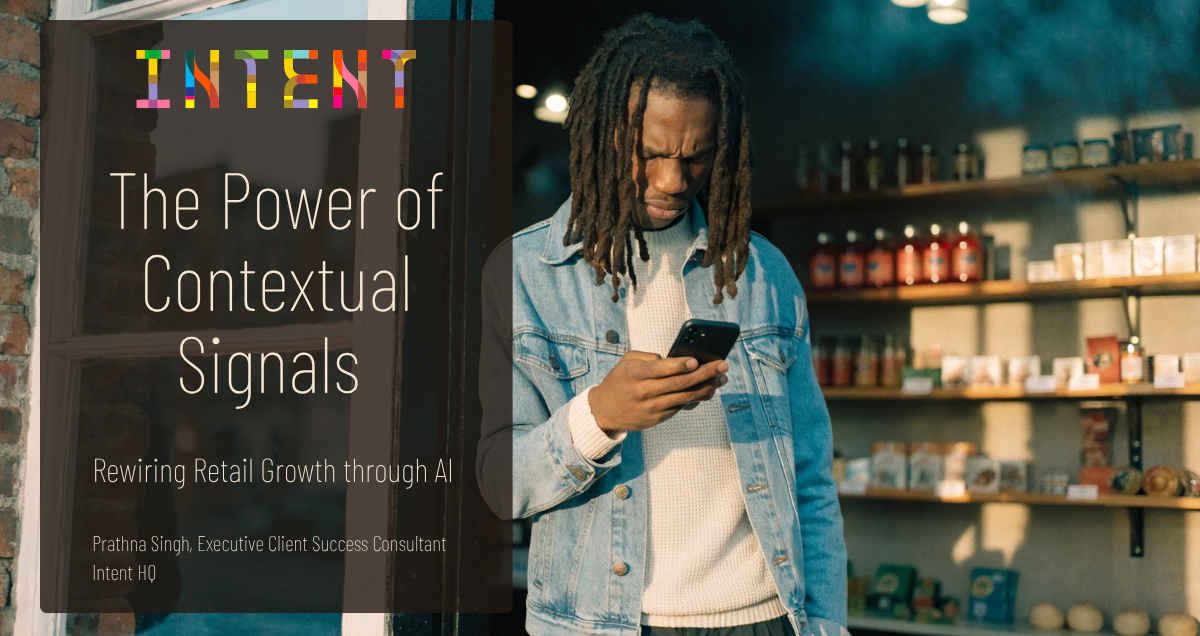
A Thought Leadership Perspective by Prathna Singh, Client Success Executive at IntentHQ, blending 20 years of experience with leading global and local brands and a deep passion for understanding human behaviour and signals to drive meaningful growth. Prathna connects her global perspective with her strong local relevance across Africa.
Retail has always been about timing – having the right product, at the right price, in the right place. Today, however, the battleground has shifted. Success is no longer defined by reacting to customer behaviour, but by anticipating intent and acting in the moment it forms. The retailers that win will be those that can move from hindsight to foresight, turning signals into action before the opportunity is lost.
Retailers are still largely operating in the dark. They do their best to optimise loyalty programmes, push targeted promotions and refine campaigns but all based on partial visibility and by looking backwards at the interactions with their customers, within their own ecosystem, and not before, or after the events.
They are blind to their customers’ brand affinities and lifestyle interests, how they shop, work and commute, their level of risk, current life stage, from moving house to starting a new job to getting married or recently becoming a parent.
They cannot see the signals that reveal more – customer intent, needs and readiness.
Having access to these signals and intent presents retailers with a more precise ‘customer moment’ and this is where contextual intelligence changes everything.
Africa isn’t a single consumer market, it’s a highly fragmented mosaic of lifestyles, cultures, income realities, and brand relationships that can vary dramatically not just by country, but within cities and even neighbourhoods.
Mobile devices in Africa act as a continuous stream of behavioural and contextual signals that are especially powerful given the continent’s diversity and mobile-first reality. Differences exist in how consumers engage with credit, insurance, or aspirational goods. At the same time, brand ecosystems are hybrid. Global brands coexist with strong local players and informal alternatives, and consumers often move fluidly between them depending on context and affordability. Whilst feature phones are still prevalent across the continent, the move to affordable smartphones is being encouraged and adopted to empower Africans to have a platform to reach digital services.
This diversity is what makes Intent HQ’s Edge AI so powerful, delivering privacy-preserving signals derived from mobile behaviour. By analysing mobile behaviour, app usage, daily routines, commute patterns, peak engagement moments, and shifts in shopping or lifestyle habits, retailers can move beyond broad assumptions like “mass market” or “affluent” and instead build granular, dynamic views of their customers. These signals give retailers the power to distinguish subtle nuances, enabling more precise decisions across product, pricing, messaging and timing – fewer interactions, higher relevance, better outcomes.
The real power of mobile-derived signals is in how they translate into creating more customer value by activating tangible, revenue-driving retail actions:
For upsell and cross-sell, behavioural patterns such as app usage, spend proxies and individual lifestyle, insights can identify customers with a higher propensity for premium products or complementary categories. For example, a customer showing increased engagement with travel, mobility or lifestyle apps can be targeted with curated bundles of luggage, apparel, FX-enabled cards or insurance at the moment intent emerges, rather than after the purchase decision is made. This enables lifestyle-based offers, imagery, messaging and timing to be tailored to each customer individually.
Contextual signals are particularly powerful in detecting life stage changes, which are often invisible in traditional data. Changes in app usage and patterns of app downloads across different categories can signal life events such as starting a new job, having a child, relocating or preparing to travel. Retailers can proactively respond with relevant offers, from travel-related products to home goods or financial services, at precisely the right moment. By blending channel behaviour with contextual mobile signals such as location, lifestyle patterns and app usage, retailers can strengthen their omnichannel proposition and identify when customers are most likely to need on-demand delivery — whether at home, at work or on the move. This enables highly personalised offers and fulfilment options to be triggered in the moment, ensuring the right product, channel, and delivery experience align seamlessly with customer needs.
For VIP identification and treatment, signals enable a far more dynamic view than static income bands. High-value customers can be identified through lookalike audiences, as well as signals such as affluent brand affinity, premium device and car ownership, international mobility, and engagement across multiple services. Retailers can then elevate these customers with personalised pricing, early access to relevant products, exclusive lifestyle-based offers and concierge-style experiences, increasing retention and share of wallet. Retailers can also pause certain communications when high-spend VIP customers are outside their local country, improving demand forecasting and maximising marketing efficiency.
Informal traders and spaza shop owners, who play a vital role in Africa’s retail economy, can be identified through signals such as early-morning activity, wholesale purchasing behaviour, movement between suppliers, and the use of mobile wallets and financial apps. Retailers can then tailor offerings such as bulk discounts, credit-lite solutions, stock financing or loyalty rewards that support business growth, rather than treating them as typical retail shoppers.
In retail media, this unlocks a far richer layer of targeting. Instead of broad demographics, retailers can offer brands access to high-value audiences defined by real behaviour — such as beauty enthusiasts identified through app ecosystems, or premium and youth segments inferred from device and lifestyle signals. Campaigns can then be activated in real time, as these audiences engage across the social platforms on their devices, at the moment of intent — transforming retail media into a precision engine focused on mindset, not just segments.
Across all these use cases, the common thread is moving from reactive, campaign-led retailing to proactive, continuous intent-driven engagement – where every interaction is informed by real behaviour, and every offer is designed to maximise relevance, conversion and long-term customer value.
Top of Form
Bottom of Form
South Africa’s retail landscape is evolving rapidly, with major retailers like Shoprite, , Pep and Woolworths leveraging their trusted brands and high-frequency customer relationships to expand far beyond traditional retail into financial services, mobile, insurance and other value-added offerings. Built on extensive store networks and deep customer loyalty, these retailers are uniquely positioned to become everyday platforms embedded in customers’ lives. This “happy network” of frequent interactions creates a powerful foundation, but the next step is deepening those relationships through relevance and personalisation. Mobile and behavioural signals play a critical role here, enabling retailers to understand not just purchase history, but how customers live, move and spend across contexts. This allows them to tailor financial products, credit, rewards, and other services to individual needs, whether it’s offering micro-insurance to a price-sensitive shopper, working capital solutions to a spaza owner, or travel-related services to an upwardly mobile customer. In doing so, signals support the shift from transactional retail to trusted, data-driven ecosystems, enabling experience-led marketing, deeper loyalty, and new revenue streams from adjacent products and value-added services.
Turning these rich, multi-dimensional signals into actionable insight is where the real complexity and opportunity lies. It requires stitching together product, transactional, CRM, loyalty, call centre, campaign response and clickstream data with powerful mobile-derived contextual signals to accurately infer intent across millions of customers.
This is where the power of Intent HQ’s Edge AI layer becomes clear. Identifying opportunities at scale and enabling brands to see the moment and act on it across cross-sell, upsell, churn prevention and acquisition with precision.
This entails aligning multiple levers simultaneously: the right product, through the right channel, at the right moment, with the right price and personalised offer and message, – all tailored at a 1:1 customer leve.
Achieving this is not just a data challenge, but an organisational one. It demands tight orchestration across product, marketing, commercial, sales, e-commerce and store teams to move from insight to execution in real time. It calls for a new operating model, where AI and the workforce work in tandem to maximise both customer impact and commercial outcomes.
Identifying intent only creates value when you can interpret what matters to your customer in the moment, enrich that understanding with behavioural signals, and act with speed and precision. This is where AI presents a step change, enabling continuous signal processing, dynamic decisioning, and automated orchestration at scale – transforming fragmented data and siloed teams into a cohesive, always-on engine for personalised growth.
As retailers work to orchestrate complex, real-time signals to deliver true 1:1 personalisation, a new challenge is emerging in parallel, the rise of agentic commerce on the customer side. In South Africa, this is already taking shape, with around 40% of shoppers now using AI tools weekly to guide purchasing decisions, and nearly two-thirds having used AI for shopping-related tasks such as product research and price comparison. In a constrained economic environment, these tools are helping consumers decide not just what to buy, but where and even whether to buy at all, signalling a shift toward more disciplined, strategic spending. This marks a shift from simply understanding customer intent to . As this evolves, retailers will not only need their own ecosystem of AI agents to process signals and trigger hyper-personalised actions at scale, they will increasingly find themselves engaging with customer-side agents that are optimising for value, convenience and relevance in real time. In this world, personalisation becomes a two-sided equation. It’s no longer just about targeting the customer, but about being discoverable, competitive and compelling to the agent acting on the customer’s behalf. This step change requires retailers to move toward dynamic, machine-driven decisioning and continuous optimisation to win each interaction.
To reflect on these questions and explore this further, do join me at our workshop ‘Turning Vision into Velocity: Practical Paths to Agentic Personalisation’ to be held at 13:45 on Monday 4th May at Converge Africa 2026.
Converge Africa is a part of a series of retail events unlike any other. It's the new unifying brand for the digital commerce value chain. Formerly ECOM Africa.
Converge Africa Conference & Expo
For enquiries contact:
T: +27 21 700 3500
T: +27 21 700 3579


.webp)

.webp)
.webp)
.webp)
