
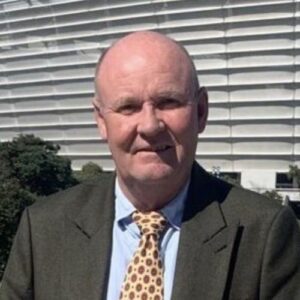
Exclusive interview with Stefano Lepore, Co-Founder and Director, Alloro Africa and Sean Varrie, Co-Founder and CTO, 4 Earth Global, who have started an exciting project, joining their respective skills in recycling waste after meeting at AGES 2024.

Interview Summary:
In this interview, Stefano Lepore, Co-Founder and Director of Alloro Africa, and Sean Varrie, Co-Founder and CTO of 4 Earth Global, discuss their pioneering collaboration transforming infectious medical waste into sustainable building materials. Alloro Africa, based in South Africa, provides hospitals with on-site frictional dry heat sterilisation systems that neutralise hazardous medical waste, eliminating the need for carbon-intensive transport and incineration. The process reduces waste volume by 75%, creating a sterile, unrecognizable, stable byproduct.
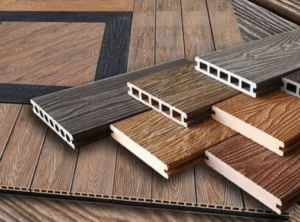
At AGES 2024, Lepore met 4 Earth Global—a company specialising in wood-plastic composites made from non-recyclable materials—and together they explored using sterilised medical waste as a raw material. Their trials successfully produced decking planks incorporating 10% of this waste, marking a world-first innovation in recycling hazardous materials into eco-friendly construction products.
Both companies envision scaling this circular solution, integrating hospital waste streams into sustainable infrastructure. Varrie notes their facilities can process 15,000 tonnes annually, enough to produce affordable homes and sanitation units across Africa. They seek investors and government support to expand operations and raise awareness about medical waste’s environmental risks.
The partners emphasise that outdated regulations, infrastructure gaps, and entrenched “landfill mentalities” remain major challenges. Yet, they see vast opportunity: technology now allows what was once considered untouchable waste to become a valuable resource. Their shared vision is to create greener, cleaner, and more self-sufficient cities—reducing emissions, promoting health, and advancing circular economies across the continent.
Thank you for joining us. Let’s start with each of you telling us more about your background and your company. How are you shaping a new narrative in waste management?
Stefano Lepore: Hi, my name is Stefano Lepore. I’m Italian. I have been living in beautiful South Africa for about 15 years, and I’m the co-founder and director of Alloro Africa. Alloro Africa offers a turnkey solution to healthcare facilities for safe on-site sterilisation treatment of medical waste. So we’re talking about medical waste, which is one of the most hazardous dangerous waste streams on earth. Obviously, medical waste is related to hospitals. Everything that has been used in terms of devices or tools or items to prick treat people becomes medical waste and has to be disposed of in a very specific way and within a certain amount of time after being generated.
Carlo Bovetti and myself started this company about 13 years ago after seeing how medical waste was managed and handled in this country, but not only in this country, which was frightening.
Still today, it requires a lot of daily transportation. There are trucks coming to the hospital to collect the medical waste that is infectious to take it to a centralised disposal site, which most of the times is an incinerator. So, you have a major carbon footprint for these daily transportations. Most of the time, the incinerator are hundreds kilometres far from the hospitals. And this leads to a lot of problems. Imagine the major environmental impact also due to the fact that so many times we have had scandals of illegal damping of this waste, where waste was left on the side of the road or damped on a beach. The problem is not only its impact on the environment, but it is also very dangerous for the communities. If by accidentally, they get in contact with this waste, they can get infected and this sometimes ends very badly.
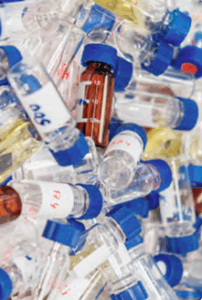
On the other hand, it is well known that emissions from incineration are carcinogenic. The problem is that there is not enough incineration capacity in this country. So we came up with a solution. We thought, how could we try to contain this, prevent all these situations, and change it? We implemented a sterilisation technology made in Italy, which works through friction. The system is installed inside the hospital. So we avoid that daily transportation of the infectious waste. And the waste, as soon as generated in the wards, gets treated and neutralised at zero emissions inside the facility. During the process, the waste is reduced by about 75% in volume and about 15% in weight. The byproduct is a new product, which is totally unrecognisable, sterile, safe, and harmless. And it looks like this. Here it is. This is one of the samples collected from one of the plants here in the Western Cape. So, for the hospital, there is obviously a huge mitigation of the risk and major reduction in terms of emissions because this waste is stable. It can sit for months and months. So, instead of doing a transportation every day, 365 trips per year, we can do it once a month. And there is also a huge financial benefit in terms of cost reduction.


Sean Varrie: Thank you. Hello, I’m Sean Varrie, the co-founder of 4 Earth Global. I’ve been in the plastics industry for some 40 years and focused on wood plastic composites for the last 30 years. We specialise in using non-recyclable materials like multilayer food packaging, sterilised medical waste and wood turbine blades. By combining these waste products together, we produce wood plastic composites, green building materials used in decking, cladding, and now in innovative construction methods.
We’ve been working with Alloro Africa for almost two years and subsequently ran trials last year by incorporating sterilised medical waste in one of our trial runs and produced it at 10% and all the lab tests and ongoing testing have proven very positive and we look forward to working with them going forward.

You met at AGES in 2024 and decided to join forces on a project. What was the initial idea, and what has happened since then?
Stefano Lepore: So, as a company, since we started with this project, we’ve always been looking for a solution on how to utilise this new byproduct. Over the years, we’ve done so many trials and tests and tried many different things. Then when we knew that we were selected for AGES, I started doing my research, not only about investors, but also about the other companies that were pitching at the event. And then when I saw 4 Earth sustainable building materials, a light switched on. I set up a meeting with them at AGES and we had a chat. I brought my best friend, the jar with the sample, to show them. They were immediately positive. And since then, we’ve worked towards this trial. We’ve had lots of meetings, information exchanges, lab analyses, et cetera, until Sean and his team managed to produce a planking deck sample using a percentage of the treated waste.
And the sample is incredible. It is the first sample that includes sterilised, treated medical waste, and has all the structural and strength characteristics that all the other 4 Earth products have. And it was really successful. So we are very, very excited because this proves that we are on the right track.
Sean Varrie: Yes, we did meet at AGES 2024. Stefano introduced himself to Carl Varrie, the other co-founder of 4 Earth Global. We opened up dialogue with regard to working with their waste and diverting it from landfill into our products, which are permanently recycled and can be guaranteed for 75 years. We look forward to progressing with them to providing solutions to local governments and even developing countries around the world.
Why is this unique?
Stefano Lepore: When we’re talking about recycling and repurposing plastic, medical waste is never part of the equation, because medical waste as it is, you cannot touch it, you cannot reuse it, you cannot recycle it. So, the fact that we combine our two solutions and allow such a hazardous waste stream to get neutralised, shredded and then repurposed into a beautiful, eco-sustainable building material. That’s what is so unique. Nobody’s ever done that before, because with medical waste is a big problem.
Sean Varrie: Agreed. With our unique technology, we agree that I don’t think this has been done before around the world by incorporating medical waste into wood plastic composites. Fortunately, with our technology, we are able to recycle and process the medical waste by extracting sharps from the material mix so that the material is safely used in the downstream process and safely incorporated into building sites with no comebacks or smells emitted from the profiles.
What is the next step? Are you looking for investors?
Stefano Lepore: Well, the next step is to make it happen. Obviously, we’re looking for investors, but we’re not starting from just an idea or just from a piece of paper. Both of us, we’ve got a lot of background. We’ve done things. In our case, we have running plants here in the Western Cape that already generate a certain tonnage of this waste.
So it’s a very good initial starting point. One of our major clients is the Western Cape Health Department that is at the forefront in terms of trying to make the hospitals in general more eco-friendly, implementing different renewable energies, looking at the medical waste in a different way. So it’s a reality. We can really make it happen by just looking at what we’ve got here in this moment and working on it. Sean and his team, they have the expertise to set up a plant. We can provide the raw material and work together with the connections that we both have. Yes, we need investors, but we particularly need people that can understand the potential that this project has and who are really committed for this to become a reality.
Sean Varrie: Yes, agreed. We are at the point of attracting investors into 4 Earth Global, currently in communications with General Electric and Tetra Tech in America with regard to our solutions to wind turbine blades. And fortunately in that industry, there’s enough media attention, but in the medical waste industry, there is not enough media attention brought to the problem, which is what we’d like to do with AGES 2026, is to focus more attention on all these problems. But we have solutions, but nothing is driving it forward.


Waste management and sustainable cities are important themes in the green economy. How will your work contribute to building greener, cleaner cities on the continent?
Stefano Lepore: Obviously, our focus is more on the healthcare sector and hospitals in general. And what I can say is that medical waste, although it is generated in much lesser quantities compared to general waste, municipal waste, etc. has a much higher environmental impact, much, much, higher. So, what we want to do is to try to empower and assist as many hospitals as possible to move into this transition, which is more a revolution than a transition towards being eco-friendlier and more independent in the generation and treatment of the medical waste, reducing the emissions, as I said before, and being in control of the full traceability.
Obviously now we are at this phase number two where we can also finally assist with the treated medical waste by manufacturing items that will be reintroduced in the economy, really making it a complete circular economy.
Sean Varrie: The 4 Earth global pod manufacturing facility can process 15,000 tons per year, and incorporated into those formulations we can use 3,000 tonnes of the sterilised medical waste. This equates to some 15,000 starter homes, which cost less than R5,000 per square metre or 60,000 toilet cubicles, which cost less than R8,000 per structure. These we believe will make a huge difference in lower income areas and developing countries around the world. We just need traction.
What in your view are the main challenges for cities? And the opportunities?
Stefano Lepore: Look, there are many challenges. We can spend two hours here naming all the challenges. But summarising, I would say the lack of infrastructure or lack of maintenance of infrastructure, but also legislation. So many times, projects get stopped
on paper because we have to face with outdated legislation that prevents progress to happen. Also, we have to deal with people’s mentality that plays a very important role; citizens, cities, we need to work to try and change the mentality of all the people to be supportive towards these new projects in terms of their benefits.
In terms of opportunities, I believe that science and technology have made so much progress and so many advances. Just thinking what was simply considered a waste until a few years ago now has become a resource. So we need to be able to use these new technologies, these new advances to our advantage to really make this project happen. Not just talking about it, making it a reality.
Sean Varrie: Challenges, again, it’s a big word that we throw around. And fortunately within society, there are people like us who come up with solutions to these challenges. Sadly, the old mentality, “out of sight, out of mind”; it’s always easier just to send all the waste to a landfill site and cover it up by nightfall. These are expensive resources in materials which we’re just burying. And most of these landfill sites have come to the end of their lifespan. And then again, there’s a challenge. Let’s dig another hole. Let’s put waste in that hole again.
We are coming to the table, providing solutions. Not only solutions to waste, but solutions to job creation, solutions to affordable homes and affordable structures in developing countries around the world. And by using our waste products that no one else is able to recycle in the plastics industry currently or in the composite industries currently creates tremendous opportunities in this field going forward.
What is your vision for this sector?
Stefano Lepore: So again, I will focus more on the healthcare sector. It is very interesting to note that healthcare sector, hospitals and medical waste, they run on two separate levels. On the one side, you have the most incredible science and technological advances and methodologies being invented to improve on how to treat patients. On the other hand, with medical waste, we still have such an outdated, polluted, high-risk system that has been the same for many, many years. And the funny thing is that one is the consequence of the other. Because yes, hospitals, do obviously this amazing thing of treating and helping people to restore their health back. But at the same time, they generate one of the most dangerous wastes on earth. And this is very scary.
Sean Varrie: Our vision has always been for decision makers to change their mindset from yesterday’s thinking to exploring opportunities going forward. When we started this journey some years ago, many people said it was impossible to do what we do. And we’ve proven them wrong time and time again. And then they said, no, you couldn’t make a product. And then we proved them wrong again. We provided the product.
Then they said you couldn’t build structures and shelters. We’ve built these structures and shelters around the world already. Yet, we still face a massive problem. For example, in Cape Town, just through the waste plastic collection scheme, there are some 6,000 tonnes a month of non-recyclable waste plastic that go to landfills. And nothing has been done about it. We’ve got the solutions, yet it’s difficult to gain traction.
Q. Any final words?
Sean Varrie: Yes, I would say that we really need to make decisions not only at grassroot levels but at decision-making levels and with local, national and international governments around the world to make a difference and no one is making that difference yet. Please.
Stefano Lepore: From my side, I can say that after all these years we’ve been looking for a solution to utilise this waste. We’ve seen crazy technologies, crazy methodologies, nothing really, really practical. For the first time, I can finally say that we are at the start of a realistic solution, a practical solution that also makes enormous business sense. So, I’m very excited about it, because we are finally going to do it, and we are the first in the world to do it. Thank you.

Africa's Green Economy Summit connects industry professionals and organisations to information and each other in a carefully curated live environment. Its purpose is to support in mobilising investments for green projects to scale up and industrialisation, which will have a significant impact on environmental sustainability and economic growth.


.webp)

.webp)
.webp)
.webp)
