Watch this webinar on-demand now!
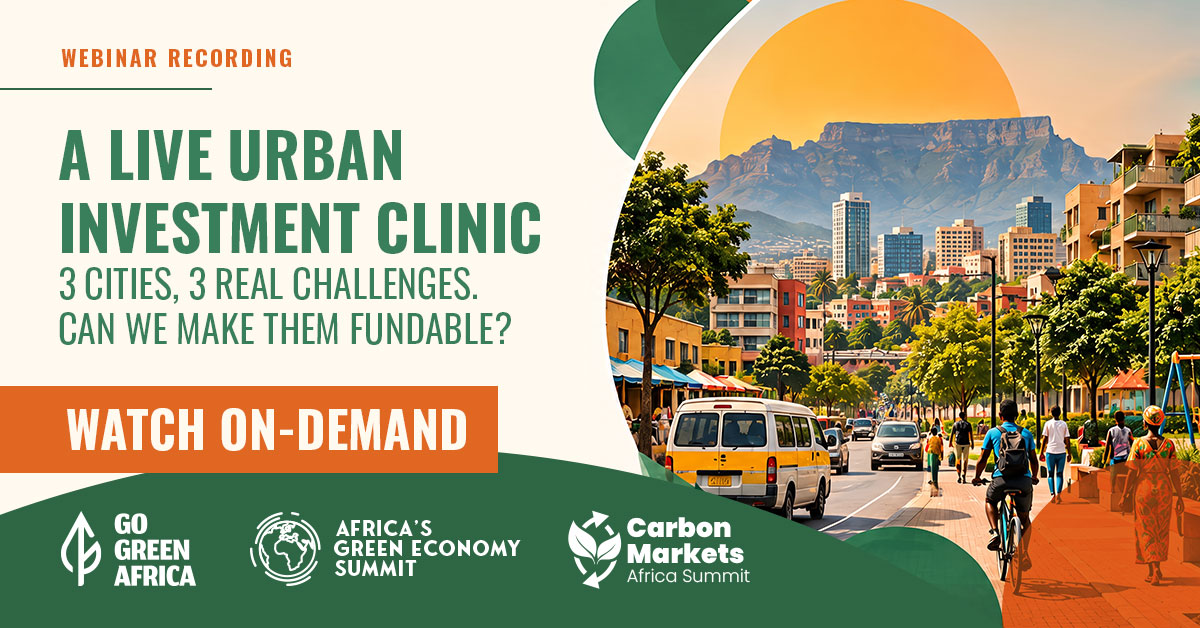
Our Live Urban Investment Clinic, hosted by the Green Economy Hub at Vuka Group as part of the build-up to Africa’s Green Economy Summit, tackled a practical question facing cities across the continent: how do we close the gap between project preparation and actual investment?
Rather than a traditional panel, the clinic put three real urban projects from Maputo, Dodoma and Accra in front of finance and urban-development experts. The cities openly shared their financing gaps, project-readiness challenges and ambitions, before experts responded with practical recommendations on blended finance, project preparation, municipal finance, land-value capture and private-sector participation.
The Live Urban Investment Clinic explored why strong infrastructure needs do not automatically translate into projects that lenders and investors can finance. The discussion demonstrated that the financing solution depends heavily on a project’s stage of development, revenue model and institutional context.
Maputo Municipal Council presented plans to scale informal-settlement upgrading, with an estimated US$61 million financing gap, while exploring a municipal urban infrastructure investment fund, land-value capture and development opportunities linked to a planned BRT corridor. Accra Metropolitan Assembly presented an organic-waste-to-compost project seeking approximately US$19 million to close its remaining financing gap. Dodoma presented an ambitious 9,000-hectare thematic satellite city, where feasibility, infrastructure preparation and demonstration of commercial demand remain critical before large-scale private investment can be mobilised.
Across all three cases, experts emphasised that cities need clearer project preparation, credible revenue and repayment mechanisms, appropriate risk-sharing, and financing structures matched to each project’s maturity. The session reinforced that urban investment readiness is ultimately about turning city priorities into structures that lenders, DFIs and private investors can confidently finance.
“How do you close the gap from preparation to make sure that you have the financing going forward?”
Watch this webinar on-demand now!
Looking to sponsor our next webinar and connect your brand with Africa’s green economy leaders? Get in touch with us to explore partnership opportunities. Contact us
Africa's Green Economy Summit connects industry professionals and organisations to information and each other in a carefully curated live environment. Its purpose is to support in mobilising investments for green projects to scale up and industrialisation, which will have a significant impact on environmental sustainability and economic growth.


.webp)

.webp)
.webp)
.webp)
