
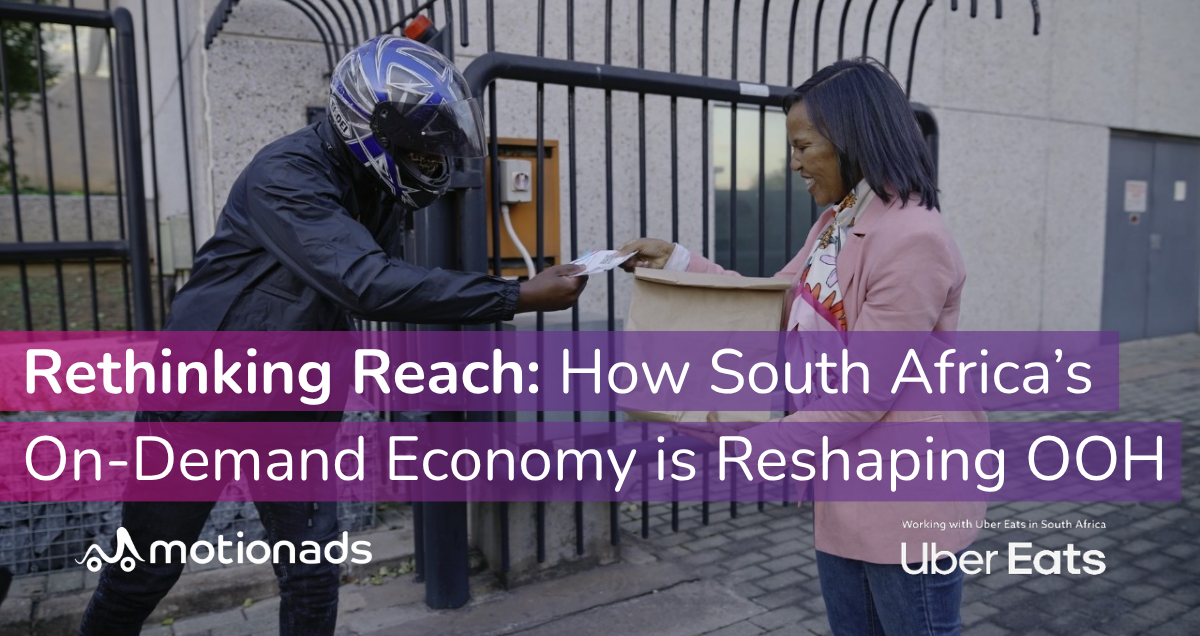
In 2026, the biggest shift in Out-of-Home isn’t where media sits, but rather, how it moves.
Consumer habits have fundamentally changed, driven by the rapid rise of on-demand services that bring products directly to people. What was once a convenience is now an expectation, and this shift has created a new mobility reality – one where attention exists in transit, in-between moments, and within the rhythm of daily life. For brands, the implication is clear: if your media isn’t moving with your audience, it’s increasingly being left behind.
Consumer behaviour is no longer predictable or tied to specific locations, it’s fluid and constantly evolving. People are no longer planning journeys around stores or services; instead, those services are coming directly to them.
Whether it’s food, groceries, or last-minute essentials, on-demand has shifted behaviour from intentional movement to passive convenience. As a result, attention has fragmented into smaller, more frequent touchpoints throughout the day: moments that are fleeting, but highly relevant.
These moments are increasingly shaped by delivery ecosystems, which now play a central role in how consumers experience brands in the real world.
The most visible signal of this shift is the rise of delivery motorbikes.
They have become a constant presence – moving through neighbourhoods, stopping at homes, navigating dense urban areas, and operating from morning through to night. These bikes are not just fulfilling demand; they are shaping a new layer of visibility across South Africa. We’ve already seen how some of the country’s largest retailers have embedded themselves into daily life through this model, becoming instantly recognisable through sheer consistency of presence.
Motorbikes have effectively become a ubiquitous, scalable media channel – one that exists exactly where consumers are, rather than where we assume they will be.
What makes this channel fundamentally different is that it is built on real behaviour, not assumed audiences. At MotionAds, we’ve demonstrated how delivery bikes can be transformed into fully integrated media platforms – from branded top boxes and helmets to in-home flyers delivered directly into consumers’ hands. At scale, thousands of drivers move according to real demand, navigating the spaces where people live, work, and spend their time.
This is not theoretical reach or projected audience data; it is a live, constantly updating reflection of consumer patterns. Mobility-led media allows brands to move beyond static placements and instead plug directly into the flow of everyday behaviour, creating a level of relevance that traditional formats struggle to replicate.
For decades, Out-of-Home has operated within a well-known constraint: the balance between reach, frequency, and impact – where achieving all three simultaneously has been difficult.
However, that model is now being challenged. With thousands of moving touchpoints active every day, mobility-led media introduces high reach through scale, high frequency through repeated exposure, and impact through consistent presence within real environments. Rather than relying on singular, high-visibility placements, it builds effectiveness through accumulation – showing up again and again, in ways that feel natural and embedded.
The result is a shift in what OOH can deliver, with new formats redefining what scale and impact actually look like in practice.
Visibility alone is no longer enough. Consumers are increasingly selective, filtering out anything that feels forced, repetitive, or out of context. What cuts through is familiarity? The sense that a brand is part of their environment rather than interrupting it. Seeing branded delivery bikes regularly, outside homes or moving through neighbourhoods, creates repeated, low-friction exposure that builds recognition over time.
This kind of presence compounds over multiple encounters, ultimately driving stronger and more durable brand recall than that of a static placement.
Mobility-led media doesn’t just reach audiences – it reaches them closer to action. Whether someone is at home deciding what to order, noticing a delivery arrive in their street, or interacting directly with a delivered item, these are real, high-intent moments. Formats such as in-home flyers or branded delivery touchpoints place brands directly within these decision-making environments, reducing the distance between awareness and action.
As a result, proximity becomes a key driver of effectiveness: The closer media sits to the moment of decision, the more influence it has.
What’s important to recognise is that this transformation hasn’t been driven by the media industry, but rather by consumers themselves.
The rise of on-demand services has fundamentally changed expectations around speed, convenience, and accessibility, creating entirely new movement patterns in the process. Media is now catching up to this reality, adapting to a world where audiences are no longer static.
Out-of-Home is no longer shaping behaviour in the way it once did – behaviour is now reshaping OOH.
At the centre of this ecosystem are the drivers themselves.
On-demand delivery has become a critical source of income for many, yet it often exists without additional avenues for earning. Recognising this, the founders of MotionAds identified an opportunity to bridge two gaps: the need for more effective, innovative OOH media, and the need to better support gig-economy workers.
By turning delivery bikes into media platforms, drivers become active participants in the value chain – earning more while enabling extended, high-frequency brand visibility. This introduces a model where media doesn’t just create value for brands, but also contributes to the ecosystem it operates within.
As this channel evolves, so too must how it is measured. Moving OOH media channels sit at the intersection of physical movement and digital reporting, allowing brands to track routes, coverage, and exposure in ways that traditional OOH has historically struggled to provide. This creates a clearer link between real-world presence and measurable performance, bringing greater accountability to the channel. As a result, the future of OOH measurement lies in its ability to connect movement with data – turning visibility into something that can be tracked, optimised, and understood in real time.
MotionAds exists at the centre of this shift. By transforming delivery bikes into moving media platforms, we’ve built a solution that reflects how South Africans live today – mobile, on-demand, and constantly in motion.
From branded bikes to in-home delivery touchpoints, we enable brands to integrate seamlessly into the flow of daily life, achieving reach, frequency, and relevance in a single ecosystem. We believe the most effective media solutions are those built around real consumer behaviour – and that is exactly where MotionAds operates.
As on-demand continues to grow, so too will the opportunity for brands to engage consumers in more relevant, consistent, and integrated ways. The lines between movement, media, and moments of influence will continue to blur, creating a new standard for how brands show up in the world. Those that adapt to this mobility reality will be best positioned to build lasting connection and recall.
The direction is clear: the future of OOH belongs to brands that move with their audience.
Converge Africa is a part of a series of retail events unlike any other. It's the new unifying brand for the digital commerce value chain. Formerly ECOM Africa.
Converge Africa Conference & Expo
For enquiries contact:
T: +27 21 700 3500
T: +27 21 700 3579


.webp)

.webp)
.webp)
.webp)
