
There is more than one answer to how much water a person needs, and the gap between them is enormous. Survival and basic hygiene require a modest amount. A dignified life requires far more.
According to the Global Commission on the Economics of Water, 50 to 100 litres per person per day is needed to meet essential health and hygiene needs: drinking, cooking, sanitation and washing.
But a dignified life, including adequate nutrition and consumption, requires a minimum of about 4,000 litres per person per day. The higher figure covers the water behind adequate nutrition and consumption, not just the water that comes out of a tap.
That second figure puts global water scarcity in perspective. Of all the water on Earth, only 3% is freshwater, and of that, only 0.4% is accessible. Much of it is also polluted. That limited supply is shared among eight billion people and unevenly distributed.
The Commission notes that most regions cannot secure 4,000 litres per person locally. Trade could help spread water resources more fairly, but misaligned policies and the water crisis itself get in the way.
At the household level, consumption varies widely. The international average is 173 litres per person per day. In eThekwini, residents use between 270 and 298 litres, which contributed to the municipality introducing water curtailment in 2024.
South Africa recognises a minimum entitlement for the poorest households. Indigent households qualify for 6 kilolitres of free basic water a month, and Section 27 of the Constitution guarantees access to sufficient water.
A South African Human Rights Commission view adds that individuals and communities carry a matching responsibility to use water efficiently and avoid waste.
CASE STUDY: Mossel Bay’s wastewater plant shows how microgrids can strengthen municipal resilience
Many people still fall short of even the basic level. In 2022, 2.2 billion people worldwide had no access to safely managed drinking water.
In Africa, the number of people without safely managed drinking water rose from 703 million in 2015 to 766 million, even though the continent receives one-third of global development assistance for water.
The Commission warns that pressure is growing. Almost 3 billion people and more than half of world food production are in areas where water storage is projected to decline.
The UN estimates that universal access to water for drinking, sanitation and hygiene will require about $114 billion a year until 2030.
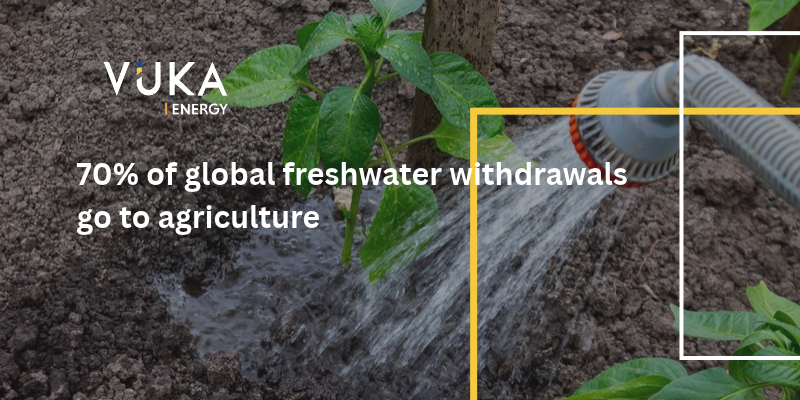
Most of the world’s freshwater goes to growing food rather than to homes. According to the UN’s 2024 World Water Development Report, agriculture accounts for about 70% of freshwater withdrawals, industry for 20% and domestic use for 10%.
Freshwater use is growing by just under 1% a year, and one-quarter of the world’s population already faces extremely high water stress, using more than 80% of its annual renewable supply.
This story was generated from the Water Industry Insights Volume 2024. For more information on the water sector across Africa go to ESI Africa’s dedicated water security content centre.
READ NEXT: Africa’s Water security challenge – why collaboration is the missing link

 Contact Us
VUKA is the trusted media partner to key professionals, policy makers, suppliers and
manufacturers. We provide unparalleled opportunities for industry-wide connection.
