The launch of the Nuclear in Africa side event at Enlit Africa 2026 marked a shift in the continent’s nuclear conversation.
Rather than debating whether nuclear energy has a place in Africa’s future, the programme focused on how countries can move from ambition to implementation through planning, institutional readiness and collaboration.
Supporting this focus, the session, A two-part African nuclear roadmap: From vision to execution, brought together government leaders, utilities, nuclear agencies and technology providers to examine the different stages of nuclear development across the continent.
South Africa, Egypt and Kenya each shared their progress, while a panel discussion tested those plans against questions of safety, regulation, financing, localisation and public trust.
Opening the session, Deputy Director General Zizamele Mbambo from South Africa’s Department of Electricity and Energy argued that Africa has reached a turning point.
“The real question before us today is how do we move decisively, responsibly and collaboratively from ambition to implementation across Africa,” he said.
He positioned nuclear energy as part of a balanced electricity mix capable of providing reliable baseload power while supporting industrialisation, energy security and decarbonisation.
At the same time, he stressed that successful nuclear programmes depend on strong governance, credible regulation, skilled human capital and long-term financing.
Programme facilitator Katse Maphoto, Chief Director: Nuclear Technology and Safety at the Department of Electricity and Energy, reinforced that the objective of the day was to examine real implementation pathways.
He noted that while South Africa operates the continent’s only commercial nuclear power station, Egypt is constructing new capacity and Kenya is advancing its own programme, illustrating that Africa’s nuclear ambitions are increasingly moving into delivery.
ALSO READ: Africa’s nuclear ambitions – why the foundations matter more than the reactors
Representing Eskom, General Manager for Nuclear Build, Lukhanyo Ndube, outlined South Africa’s plans under the Integrated Resource Plan 2025 and reflected on nearly two decades of preparation.
“We have been on a 19-year journey,” he said. “We have learnt many lessons.” Ndube described it as an opportunity to improve future delivery. He identified three areas where previous programmes had provided valuable experience:
He argued that transparent procurement and disciplined governance would be essential to delivering South Africa’s planned nuclear expansion while avoiding the challenges experienced in previous programmes.
The presentation also emphasised localisation, skills development and selecting proven reactor technologies rather than first-of-a-kind designs.
According to Ndube, long-term operation should be considered from the earliest stages of planning, drawing on Koeberg’s successful life extension as an example of the value of sustained maintenance and operational discipline.
Sengiphile Simelane, Group Executive: Power and Industry at South African Nuclear Energy Corporation (NECSA), focused on the wider nuclear value chain rather than generation alone.
He explained that South Africa’s ambitions extend beyond operating reactors to rebuilding domestic capabilities across the nuclear fuel cycle, including fuel production, research infrastructure and small modular reactor (SMR) development.
NECSA outlined plans to support:
Simelane stressed that success would depend on consistent policy, disciplined programme governance, transparent procurement and investment in local industrial capability and human capital.
Ryan Collyer, CEO of Rosatom South Africa, presented Egypt’s El Dabaa nuclear power project as an example of large-scale nuclear delivery already underway on the continent.
He described the project as a four-unit Generation III+ nuclear power station with a total planned capacity of 4.8GW, highlighting not only construction progress but also the institutional structures supporting implementation.
According to Collyer, Egypt invested significant time in establishing governance structures before construction began, including clear separation between the owner, operator and regulator. He argued that this institutional maturity has strengthened both project delivery and public confidence.
The presentation also highlighted localisation, with Egyptian companies participating in construction and thousands of local specialists undergoing training to support future operations.
Rosatom’s approach, he said, extends beyond reactor construction to include long-term skills development, supplier development and public engagement programmes designed to build understanding of nuclear technology.
Professor Lawrence Gumbe, Chairman of Kenya’s Nuclear Power and Energy Agency (NuPEA), presented Kenya’s long-term vision for nuclear energy as part of the country’s wider economic development strategy.
He explained that increasing electricity consumption is fundamental to achieving Kenya’s Vision 2030 objectives and argued that nuclear power will play an important role in meeting future demand.
Kenya has already established the institutions required to advance its programme, including the Nuclear Power and Energy Agency, the Kenya Nuclear Regulatory Authority and the appointment of Kenya Electricity Generating Company (KenGen) as owner-operator.
While acknowledging that small modular reactors may have an important future role, Gumbe noted that Kenya’s immediate priority is securing large-scale generation capacity.
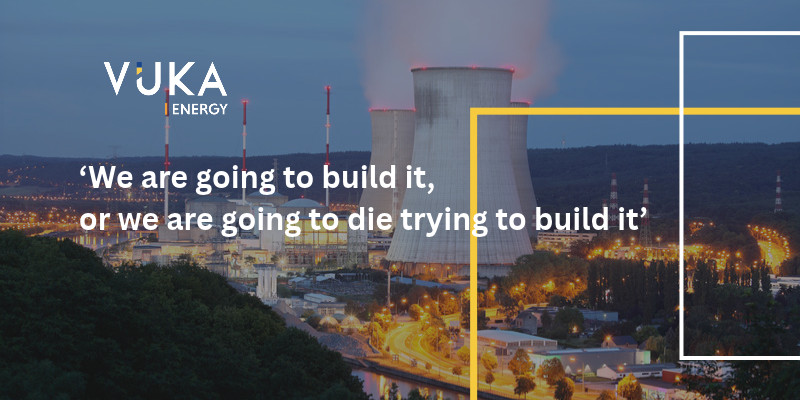
Closing his presentation, he reaffirmed the country’s determination to move forward: “We are going to build it, or we are going to die trying to build it.”
Following the presentations, the speakers participated in a moderated discussion titled The Critical Interrogation, where the emphasis shifted from presentations to accountability.
Rather than accepting national plans at face value, the discussion examined practical issues including proven technology, regulatory readiness, financing, localisation, workforce development and long-term operational capability.
Ndube argued that decades of operating Koeberg have demonstrated the importance of planning for long-term operation from the outset, while governance and skills development remain central to successful delivery.
Collyer identified political commitment and investment in human capital as two of the most important lessons from Egypt’s programme, noting that nuclear development requires long-term national commitment rather than short-term project planning.
Gumbe emphasised that while SMRs offer opportunities, Kenya’s immediate challenge remains meeting rapidly growing electricity demand through reliable large-scale generation.
Across the discussion, a consistent theme emerged: successful nuclear programmes depend on institutions, people and governance as much as technology itself.
The Nuclear in Africa launch session demonstrated that countries across the continent are progressing at different stages of nuclear development, from South Africa’s operational experience to Egypt’s active construction programme and Kenya’s preparations for first deployment.
While each country faces different circumstances, the discussions repeatedly returned to common requirements: political commitment, regulatory maturity, transparent procurement, financing certainty, localisation and long-term skills development.
Together, the presentations reflected the central message of the session’s theme: Africa’s nuclear conversation is increasingly moving beyond vision and towards execution.
READ NEXT: In the hot seat at Enlit Africa – financing, grids and regional cooperation dominate nuclear debate

 Contact Us
VUKA is the trusted media partner to key professionals, policy makers, suppliers and
manufacturers. We provide unparalleled opportunities for industry-wide connection.