For millions of people living in informal settlements, electricity remains caught between aspiration and reality.
Communities need safe and reliable energy to study, work, run businesses and live with dignity, yet conventional electrification models often struggle to reach them.
That was the central challenge explored during the “Electrifying the Unelectrifiable” session at Enlit Africa 2026, moderated by Qhakazile Mathebula, Acting General Manager for Business Development at City Power.
The discussion brought together representatives from the City of Cape Town, City of Johannesburg, City of Tshwane, eThekwini Municipality and private-sector energy provider Zonke Energy to examine why informal settlements remain difficult to electrify and, more importantly, whether the problem lies with the communities themselves or with the models being used to serve them.
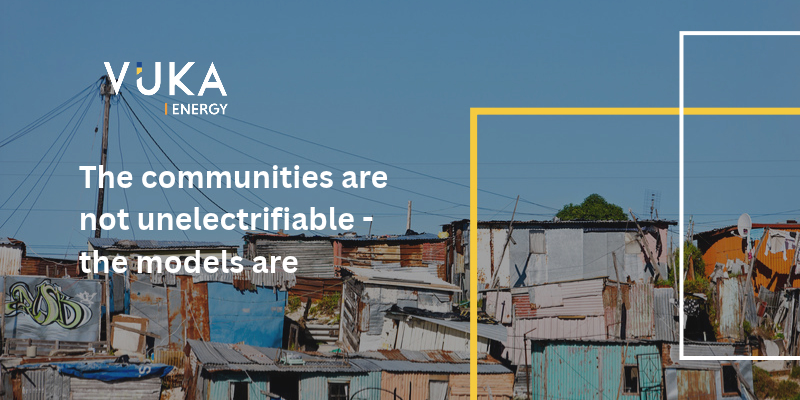
The conclusion was that communities are not necessarily unelectrifiable. It is often the policies, planning processes, infrastructure models and assumptions surrounding electrification that have failed to keep pace with urban reality.
Opening the discussion, Mathebula described Africa as not energy poor, but “energy misallocated.” The continent has exceptional solar and wind resources, yet millions of people remain without formal access to electricity and, in many cases, depend on illegal connections.
This creates a difficult paradox for municipalities.
Informal settlements are expanding rapidly, often faster than infrastructure planning and electrification programmes can respond. At the same time, existing networks are ageing and increasingly constrained.
The result is a combination of technical and non-technical losses, overloaded infrastructure, electricity theft, illegal connections and significant safety risks.
But behind these non-technical challenges is a human reality.
As the panel repeatedly emphasised, illegal connections cannot simply be understood as a technical or enforcement problem. For many residents, the choice is binary: an illegal connection or no electricity at all.
The challenge therefore becomes how municipalities can provide a safe, affordable and legal alternative before residents are forced to find their own.
One of the strongest messages from the session was that municipalities need to change how they conceptualise informal settlements.
These communities are often treated as temporary spaces awaiting relocation or formal housing. Yet the reality on the ground is very different.
They are economically active communities, often located close to employment opportunities and urban centres, and many continue to grow.
Johannesburg’s experience illustrates this clearly. Charles Maboko of City Power highlighted the continued movement of people into Johannesburg in search of economic opportunities and the pressure this place on informal settlements and the electricity network.
For municipalities, this creates a fundamental planning challenge.
If informal settlements are treated only as temporary emergencies, infrastructure investment will remain reactive.
If they are recognised as part of the long-term urban landscape, municipalities can begin planning services, networks and investment around the realities that exist today.
This does not necessarily mean abandoning the objective of formal housing. Rather, it means recognising that people cannot be expected to wait indefinitely for formalisation before receiving basic services and protection.
The panel agreed that the conventional grid model was largely designed around formal, permanent urban structures. Informal settlements present a very different set of conditions.
Settlements can be extremely dense, with narrow pathways and limited access for construction vehicles. Others are located on privately owned land, wetlands, flood-prone areas or beneath high-voltage power lines.
In some cases, land-use or safety restrictions make conventional grid infrastructure impossible.
City Power’s experience highlighted another challenge in that infrastructure can be planned and funded but still prove extremely difficult to build.
In densely populated settlements, there may simply be no access for trucks, poles or construction equipment. Community disruptions, contractor cash-flow challenges, procurement delays and construction-related disruptions can further delay projects.
This creates what the panel described as a gap between planning and execution.
Municipalities may have master plans and electrification strategies, but those plans depend on multiple actors, including human settlements, spatial planning, procurement, finance, communities and infrastructure departments.
The electricity department is often at the end of a much longer value chain.
ALSO READ: What municipal utilities need to succeed in South Africa’s new electricity market
The session made clear that the future of informal-settlement electrification cannot depend exclusively on extending the conventional grid.
A range of alternative technologies and service models are emerging, including:
The important shift is technological and conceptual.
Instead of asking, “How do we extend the grid into this settlement?”, municipalities need to ask, “What is the safest, most affordable and most resilient way of providing energy to this community?”
That distinction opens the door to different technologies for different circumstances.
The City of Cape Town provided a suitable example of this approach.
Imran Chotia explained that the city has made significant progress in electrification, with a high electrification rate across city-supplied areas. However, informal settlements continue to grow faster than the pace of electrification, leaving a backlog.
One of the city’s emerging priorities is therefore to develop temporary energy solutions while formal electrification is being pursued.
The logic is straightforward. Municipalities already provide temporary solutions for other essential services. Waste can be removed by trucks and temporary sanitation solutions can be deployed where permanent infrastructure does not yet exist.
Electricity, however, has traditionally had no equivalent temporary service.
To solve the problem, Cape Town is exploring microgrids, alternative lighting solutions and other temporary provisions, including work undertaken through partnerships with organisations such as GIZ and private-sector innovators.
The principle is not to replace eventual permanent electrification, but to provide a bridge between today’s reality and tomorrow’s infrastructure.
Alex Densmore of Zonke Energy provided a practical example of what this alternative approach can look like.
Zonke Energy focuses specifically on informal settlements where conventional electrification is not currently feasible because of factors such as land restrictions, wetlands or locations beneath high-voltage infrastructure.
Its model uses modular low-voltage DC systems incorporating solar PV and battery storage. The systems can be deployed within dense settlements without requiring the same scale of construction infrastructure associated with conventional grid projects.
The model also introduces an important dimension of revenue collection.
Customers can pay through digital channels or vouchers, with energy access managed through a prepaid platform.
Rather than replicating a traditional electricity tariff, the model manages the amount of energy available to households according to the service level they purchase.
The experience demonstrates that informal settlements should not automatically be viewed as environments where revenue collection is impossible.
The more fundamental question is whether the service is affordable, accessible and designed around the realities of the community.
The issue of affordability emerged repeatedly during the discussion.
An energy solution may be technically innovative, but if the poorest households cannot afford it, it will not solve the access problem.
Densmore acknowledged that off-grid electricity can initially be more expensive per unit than conventional grid electricity.
This creates a policy question of whether households with the least financial capacity should end up paying more for electricity simply because they live in areas that are harder to serve?
The panel argued that this cannot be ignored.
Subsidies, Free Basic Electricity (FBE) mechanisms and more flexible policy frameworks may need to evolve to accommodate different technologies and service models.
The current policy environment can also unintentionally exclude the very households that need assistance most.
As Densmore noted, access to FBE traditionally depends on having the appropriate metering arrangement. Households without formal connections can therefore struggle to benefit from support designed for low-income consumers.
This points to a broader principle that energy policy needs to become technology-neutral and customer-focused rather than assuming every household will eventually receive electricity through the same grid-based model.
Perhaps one of the most important lessons from the discussion was that implementing technology will not solve the problem on its own.
Municipalities are dealing with complex informal power structures, illegal connections, community mistrust and, in some cases, informal electricity networks operated by local syndicates.
Attempts to remove illegal connections can therefore become cyclical. Municipal teams disconnect the infrastructure, communities reconnect it, and the problem returns.
The panel argued for a different approach that works with communities rather than treating them only as recipients or enforcement targets.
One practical suggestion was to involve residents directly in registration, awareness, metering and infrastructure protection.
Residents understand their communities.
They know where households are located, who needs assistance and where illegal connections exist. Bringing them into the service-delivery process could simultaneously create employment, improve trust and strengthen infrastructure protection.
This shifts community engagement from a communications exercise to an operational tool.
An important distinction also emerged between electrification and lighting.
Where full electrification is not immediately possible, public and household-level solar lighting can provide an important first layer of service.
Cape Town’s experience with solar lighting pilots highlighted the potential benefits. In densely populated areas, structure-mounted lighting can be more practical than conventional streetlights because it is easier to install and maintain.
The benefits extend beyond visibility.
Lighting can improve residents’ ability to move around their communities after dark and can contribute to a greater sense of safety and dignity.
The discussion noted that residents may avoid using sanitation facilities at night in unlit settlements, while emergency and security services can face challenges accessing such areas in the dark.
Lighting is therefore also a public safety and social infrastructure intervention.
The challenge becomes even more complex as climate risks increase.
Flood-prone areas and unstable land have traditionally been classified as unsuitable for infrastructure. But as climate change increases the frequency and severity of extreme weather events, municipalities are being forced to rethink what resilient infrastructure looks like.
eThekwini’s experience following the 2022 floods reinforced this point.
The challenge is increasingly about whether infrastructure can be designed to withstand, adapt to or be relocated in response to changing conditions.
The panel discussed possibilities such as elevated kiosks, temporary reticulation, solar mini-grids and containerised battery storage as examples of infrastructure that can potentially provide greater flexibility.
This represents a significant shift in engineering philosophy to designing for the reality that exists, rather than waiting for the reality to become ideal.
Even the best technology will remain limited if municipalities cannot finance its deployment.
The panel highlighted the challenge of shrinking grants, rising construction costs and long project cycles. Delays can mean that by the time funding becomes available, the original budget is no longer sufficient to deliver the intended infrastructure.
There was therefore a call for more predictable and flexible funding models.
The discussion also opened an important opportunity around climate finance and private investment.
As significant capital flows into renewable energy and utility-scale projects, the panel questioned whether some of that investment could be linked to energy-access initiatives for low-income communities.
Climate finance, renewable energy credits and other mechanisms could potentially help connect the energy transition with social inclusion.
This is an opportunity is to ensure that the transition to a cleaner energy system creates:
Perhaps the most persistent frustration expressed during the session was the gap between research, policy and implementation.
Municipalities conduct studies. Strategies are developed. Master plans are prepared. Policies are written.
But implementation remains slow.
The panel’s message was not that planning is unnecessary. Rather, planning must become more closely connected to execution.
This requires better coordination between: Human settlements + spatial planning + electricity + finance + procurement + communities + private sector + policymakers.
Instead of each department operating sequentially, these functions need to operate as an integrated delivery model:
The objective should be to eliminate the gaps where projects become stuck between departments.
The most powerful conclusion of the session was perhaps the rejection of the word unelectrifiable.
The term suggests that the problem lies with the community.
The discussion suggested that while a settlement may be difficult to electrify through a conventional grid – due to its location, density, land status, safety conditions or infrastructure constraints – that does not necessarily mean that the community cannot receive electricity services.
It may simply require a different service model.
That could mean a conventional grid connection in one settlement, a microgrid in another, solar home systems somewhere else, or temporary lighting and modular infrastructure while a long-term solution is developed.
The future may therefore not be about finding one solution for informal settlements, but developing a portfolio of solutions matched to different circumstances.
The session ended with a call to action to incorporate informal settlements into long-term infrastructure planning rather than treated solely as emergency interventions.
Municipalities need stronger integrated operational models, more flexible funding, technology-neutral policies and meaningful community participation.
They also need to become more comfortable with responsible experimentation.
While innovation inevitably carries risk, the panel’s argument was that the risk of doing something different may be smaller than the risk of continuing with a model that is already failing to reach growing communities.
One of the session’s closing reflections captured it as not letting perfection be the enemy of delivering services. That may be the most important lesson for the future of energy access.
Waiting for formal housing, perfect land conditions, complete planning processes or conventional grid infrastructure to arrive before providing any meaningful energy service leaves communities waiting indefinitely.
The goal should instead be to provide the safest, most affordable and most appropriate level of energy access possible today, while continuing to work towards permanent solutions.
If municipalities, communities, policymakers and the private sector can move beyond conventional assumptions, informal settlements can become more than a difficult distribution problem.
They can become a testing ground for a new generation of flexible, decentralised and inclusive energy systems.
And ultimately, the measure of success will be the number of connections installed, along with whether electricity helps people live more safely, participate more fully in the economy, educate their children, protect their communities and experience the dignity that access to energy can provide.
READ NEXT: Africa’s Water security challenge – why collaboration is the missing link

 Contact Us
VUKA is the trusted media partner to key professionals, policy makers, suppliers and
manufacturers. We provide unparalleled opportunities for industry-wide connection.