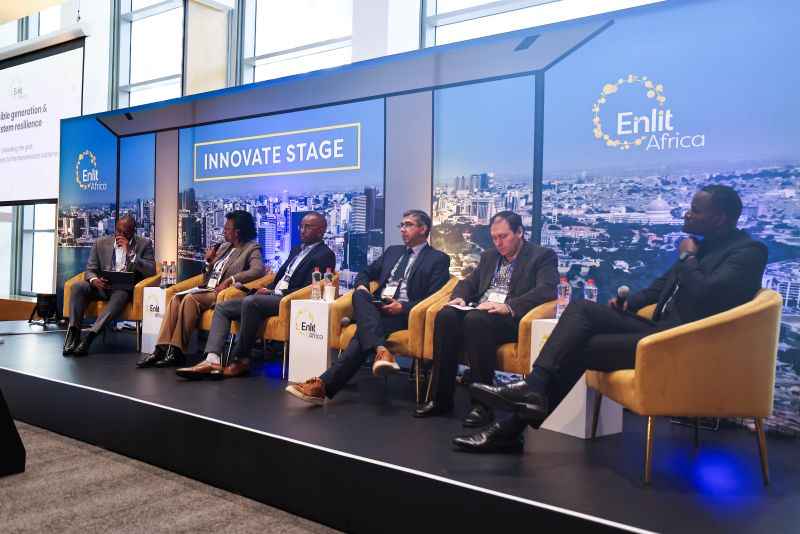
As renewable energy deployment accelerates across Africa, transmission infrastructure is emerging as one of the greatest constraints to expanding electricity access and enabling regional power trade.
While investment in generation continues to grow, panellists at Enlit Africa, agreed that without a stronger transmission network, many projects will remain stranded, regardless of how much generation capacity is developed.
The transmission bottleneck session examined the financial, regulatory and operational barriers preventing transmission infrastructure from keeping pace with Africa’s energy ambitions. Bringing together representatives from the:
the discussion focused on how governments, financiers and utilities can work together to unlock investment in the regional grid.
Opening the discussion, Wilson Masango of SAPP, who moderated the session highlighted the scale of the challenge facing Southern Africa’s electricity market.
Despite growing demand for regional electricity trade, transmission bottlenecks continue to prevent available power from reaching customers.
The panel heard that during the financial year ending March 2026, more than 1,000 GWh of electricity could not be traded despite willing buyers and sellers because transmission constraints prevented power from flowing across the network.
While significant transmission expansion is planned, including approximately 14,000 kilometres of new transmission lines in South Africa and multiple regional interconnector projects, delivery has remained slow.
Jean Madzongwe, Programmes Manager for SAPP’s Project Advisory Unit, explained that many transmission projects have already completed technical and environmental feasibility studies with support from development finance institutions and donors.
The challenge, she said, is moving these projects beyond preparation into financial close and construction. Utilities often have differing credit profiles, regulatory environments vary across participating countries, and sovereign risk remains a significant concern.
As projects remain delayed, studies frequently require updating before investors are willing to proceed, adding further cost and slowing progress.
READ NEXT: How South Africa’s electricity market reforms will change electricity prices
Keith Katyora, Senior Manager for Grid Expansion and Energy Systems at the Energy Council of South Africa, argued that transmission projects should not be assessed purely on their technical merits.
According to Katyora, bankability depends on the strength of the entire investment ecosystem. This includes credible national planning, supportive regulatory frameworks, clear policy alignment, appropriate risk allocation and political commitment.
He also noted that each country has different development priorities. While South Africa is focused on reindustrialisation, other countries prioritise electrification, agricultural growth or reducing diesel dependence.
He suggested that regional planning should reflect these differing national objectives while identifying shared investment opportunities that support broader regional development.
From the banking perspective, Sameer Bagwandeen, Head of Energy and Infrastructure for Business and Commercial Banking at Standard Bank, explained that financiers require predictable cash flows before transmission projects become investable.
Unlike power generation projects that rely on long-term power purchase agreements, transmission infrastructure serves broader public objectives and often lacks a clearly identifiable revenue stream.
Bagwandeen suggested that availability-based revenue models could provide a solution, where infrastructure operators receive agreed payments for making transmission capacity available regardless of the amount of electricity flowing through the network.
Combined with political certainty, sovereign support where required and mechanisms to manage currency fluctuations, such approaches could significantly improve project bankability.
Ronald Marais from NTCSA encouraged participants to rethink how transmission infrastructure is valued.
Rather than focusing solely on increasing the number of transmission lines, he argued that the priority should be creating secure transfer capacity that strengthens regional reliability, supports renewable integration and reduces overall system costs.
He explained that interconnectors deliver value beyond electricity trading by improving system flexibility, reducing curtailment and sharing reserve capacity across countries.
Recognising these broader regional benefits could strengthen the case for investment and regulatory support.
Billy Onyango from Kenya Power shared Kenya’s experience of accelerating transmission development through strong government support.
Recognising that many large transmission projects could not easily demonstrate immediate commercial returns, Kenya established a government-owned transmission vehicle to receive bilateral development funding, implement projects and retain ownership before handing assets to the utility for operation.
He noted that while last-mile transmission projects serving individual industrial customers may attract private investment, broader network expansion often requires government backing or development finance because the economic benefits extend beyond individual revenue streams.
To help address financing challenges, Madzongwe outlined SAPP’s plans to establish a Regional Transmission Infrastructure Financing Facility (ARTIF).
The blended finance facility is intended to combine commercial finance, public funding, multilateral support, debt and equity to reduce project risk and accelerate investment.
With between 20 and 30 regional transmission projects already considered investment-ready, and many more included in the SAPP Plan, the facility aims to improve coordination between governments, financiers and private investors.
Throughout the discussion, speakers consistently returned to the importance of policy certainty.
Whether discussing regulatory reform, sovereign guarantees, regional cooperation or utility responsibilities, panellists agreed that stronger coordination between governments, regulators, financiers and utilities will be essential if Africa is to build the transmission infrastructure needed for its growing electricity market.
The discussion concluded that expanding generation alone will not deliver reliable, affordable electricity across the continent.
Investment in transmission must become a strategic priority if regional power pools are to function effectively, renewable energy is to be integrated at scale, and future electricity demand is to be met.
ALSO READ: Africa’s data centre problem isn’t capital, it’s bankability – here’s why

 Contact Us
VUKA is the trusted media partner to key professionals, policy makers, suppliers and
manufacturers. We provide unparalleled opportunities for industry-wide connection.