
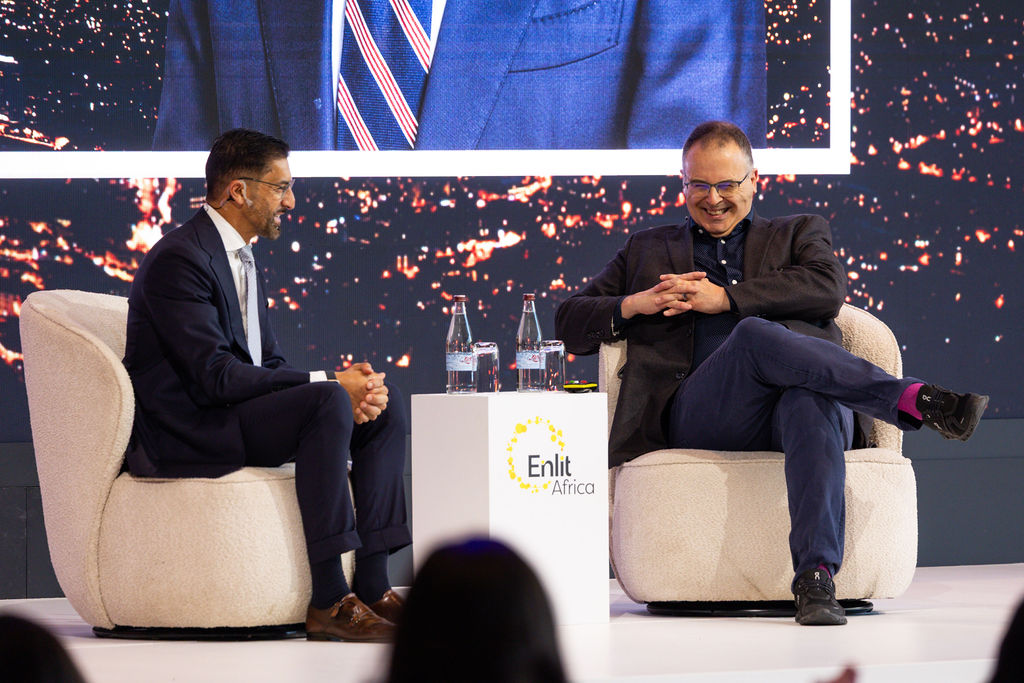
At the Project & Investment Network breakfast at Enlit Africa in May, Standard Bank Chief Economist Goolam Ballim framed a fast-shifting geopolitical environment around one central idea: as global trust fractures, supply chains and investment decisions are being rebuilt around reliability rather than pure efficiency.
In that recalibration, Africa is no longer peripheral to the global economy’s next chapter. It is increasingly central to it.
Ballim’s argument is that the world is moving from the last three decades’ “just-in-time” logic towards a “just-in-case” mindset — designing systems that can absorb shocks, manage disruptions, and still deliver.
This shift is already reshaping trade flows, capital allocation, and energy strategy.
Ballim described a world in which geopolitical uncertainty is no longer background noise; it is becoming the organising principle of global commerce.
As transatlantic ties fray and rules-based norms weaken, companies and governments are placing a premium on dependable partners, secure routes, and predictable policy environments.
In practical terms, this means supply chains are being redesigned with resilience and continuity in mind.
The implication for Africa is significant: economies that can offer credible, stable operating conditions — and dependable delivery of energy and resources — become strategically valuable in a world that is actively diversifying away from single points of failure.
Ballim argued that Africa is entering a rare window of opportunity to participate in a global “trust re-ordering”.
In his view, this is not simply deglobalisation, but the emergence of curated blocs and “friend-shoring/ally-shoring” dynamics — where relationships are selected and reinforced based on perceived reliability.
Within that, Ballim highlighted a “geographical arc of prosperity” — Africa, the Middle East and the Far East — as a key corridor for new economic linkages and opportunity.
The core message for energy stakeholders is that the investment map is being redrawn in ways that can favour African markets that are able to scale, industrialise, and deliver infrastructure at pace.
ALSO READ: Why trust is becoming the most valuable asset in Africa’s energy investment
Ballim’s remarks carry direct implications for the energy transition and where capital may flow next.
First, the transition is increasingly understood as a competition for secure inputs — from oil and fertiliser shocks in the short term, to critical minerals and industrial supply chains over the longer arc.
In this environment, Southern Africa’s “optionality value” rises: the region can be positioned as a partner of choice for critical minerals, energy-transition inputs, and new manufacturing ambitions that require political distance from major-power rivalry.
Second, Ballim’s view suggests that energy investment decisions will be shaped as much by geopolitics and security-of-supply as by levelised cost alone.
Reliability of infrastructure, clarity of regulation, and the ability to deliver projects without prolonged disruption become central to investment confidence — especially for long-life assets in generation, transmission and logistics.
Third, Ballim emphasised that this decade is Africa’s to lose.
The opportunity is not automatic. It depends on execution: building credible energy frameworks, expanding grid capacity, enabling bankable projects, and creating investable pathways for both conventional and clean energy expansion.
Ballim sketched a medium-term growth picture in which Africa’s macro prospects improve materially over the next decade, with East Africa positioned as a growth engine, West Africa offering scale and entrepreneurial momentum, and Southern Africa carrying strategic optionality — but also facing constraints that could keep growth uneven.
For energy developers and investors, the takeaway is that Africa should be approached as a differentiated set of markets with different risk profiles and different routes to scale.
The opportunity is continent-wide, but outcomes will be uneven — and will favour countries that can convert geopolitical relevance into project delivery.
A final point Ballim made is that financial institutions cannot remain passive intermediaries. In a world where trust is a scarce asset, banks and large balance-sheet actors must increasingly become enablers: leaning into the ecosystem with regulators, sharing risk in more sophisticated ways, and helping shape credible frameworks that attract long-term capital.
For the energy transition, this “enabler” stance matters.
Grid build, storage, gas-to-power bridging, renewables scale, and industrial decarbonisation will not move at the required pace without coordinated capital, credible policy and risk-sharing structures that match the realities on the ground.
Ballim’s central message is that Africa’s strategic relevance is rising in a world searching for reliable partners, resilient supply chains and investable growth corridors.
For the energy sector, the implication is clear: the transition will follow trust.
Countries and projects that can demonstrate bankability, regulatory credibility, delivery capacity and infrastructure reliability will increasingly sit at the centre of energy investment flows – not despite global fragmentation, but because of it.
READ NEXT: Africa’s Water security challenge – why collaboration is the missing link

 Contact Us
VUKA is the trusted media partner to key professionals, policy makers, suppliers and
manufacturers. We provide unparalleled opportunities for industry-wide connection.
