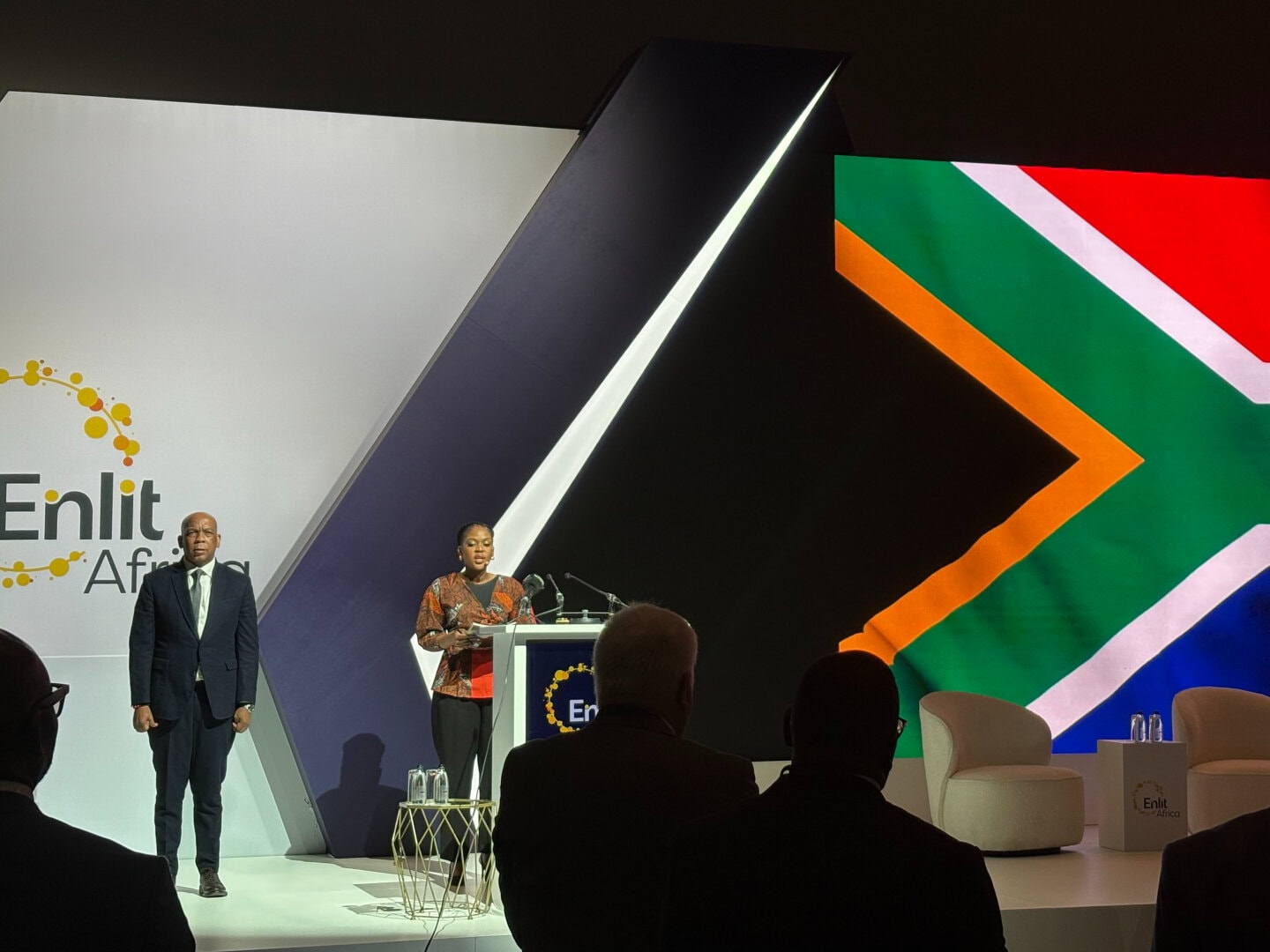
On the opening day (20 May) of Enlit Africa 2025 at the Cape Town International Convention Centre, South Africa’s Minister of Electricity and Energy, Dr Kgosienthso Ramokgopa said the conversation around the just energy transition is not “a binary one.”
For the first time, the conference is co-located with a new event – Water Security Africa.
Describing Enlit Africa as an “emblematic conference,” Ramakgopa said water and energy as foundational networks cannot be decoupled if we are to have sustainable development which will encourage human capability and endeavour.
“For us to achieve the development we desire… we must have a conversation around energy sources… and it’s not [just] a conversation between fossil fuels and renewable energy [sources]. It’s… not a binary conversation.”
He said the world is facing an energy trilemma and used the Russia-Ukraine war as an example of how that conflict impacted energy security, especially driving gas scarcity supplies to Europe.
In terms of energy access in Africa, Ramakgopa said the challenge is not homogenous, but that “there are features that are common.”
He said these include:
He said the continent needs to “articulate our own transition with African characteristics.”
“The social economic dimension of this transition… is another aspect of achieving energy security.” He highlighted the African Union’s goal of achieving universal energy access by 2063 through regional integration.
However, this will require “massive infrastructure investments” and given that Africa’s share of global energy remains below 5%, this highlights the finance gaps that exist.”
Ramokgopa noted that unlocking Africa’s energy potential requires more investment, especially from the private sector.
He noted that South Africa is instituting a credit backstop, a measure he said is accepted by the private sector.
“This will serve as a backstop… it will unleash the transmission network.”
The country’s Transmission Development Plan is aiming to connect 53GW over the next 10 years by building nearly 14,000kms of new transmission lines and 122,000 MVA of new transformer capacity.”
This would cost at least R400 billion, with the government not wanting to overburden the fiscus, said Ramokgopa.
The Minister acknowledged that this will require a “hybrid delivery model leveraging private sector capacity to accelerate delivery.”
He also highlighted the following challenges Africa continues to face:
But there are also numerous positives for Africa to anchor its energy ambitions on:
Ramokgopa said South Africa is well-endowed with nuclear capability and should use this to align with the global consensus that nuclear power will play a critical role in mitigating climate change.
He said SMRs present an opportunity for African countries to improve energy access and security for “both big and small regional grids.”
The Minister said energy is used as an instrument of diplomacy to punish and incentivise… “[but] we have to appreciate the role of nuclear.”
South Africa’s power utility, Eskom, he said, will maintain its market share with a mix of new clean energy capacity including gas, nuclear and renewables.
“Nuclear moves Africa closer to its goals of stimulating economic activity for growth while meeting environmental responsibilities.”
In terms of Africa’s critical minerals endowment, the Minister said what is needed is “shared exploitation of these resources for the advancement of the continent.”
Ramokgopa said capital investment is required to help Africa build up critical mineral reserves.
“The business case is about exporting… there is a delay in the realisation of these endowments. We have the [critical minerals] resources and they have the money.”
The Minister called on the engineers and scientists at the conference to assist the government in finding solutions to address the South Africa’s energy challenges and to help it each energy security ambitions.
He lauded Enlit Africa as a “substantive conference” that asks questions pertaining to developing solutions to the energy and water challenges facing Africa and the world.
Enlit Africa 2025 runs until Thursday (22 May).
 Contact Us
VUKA is the trusted media partner to key professionals, policy makers, suppliers and
manufacturers. We provide unparalleled opportunities for industry-wide connection.