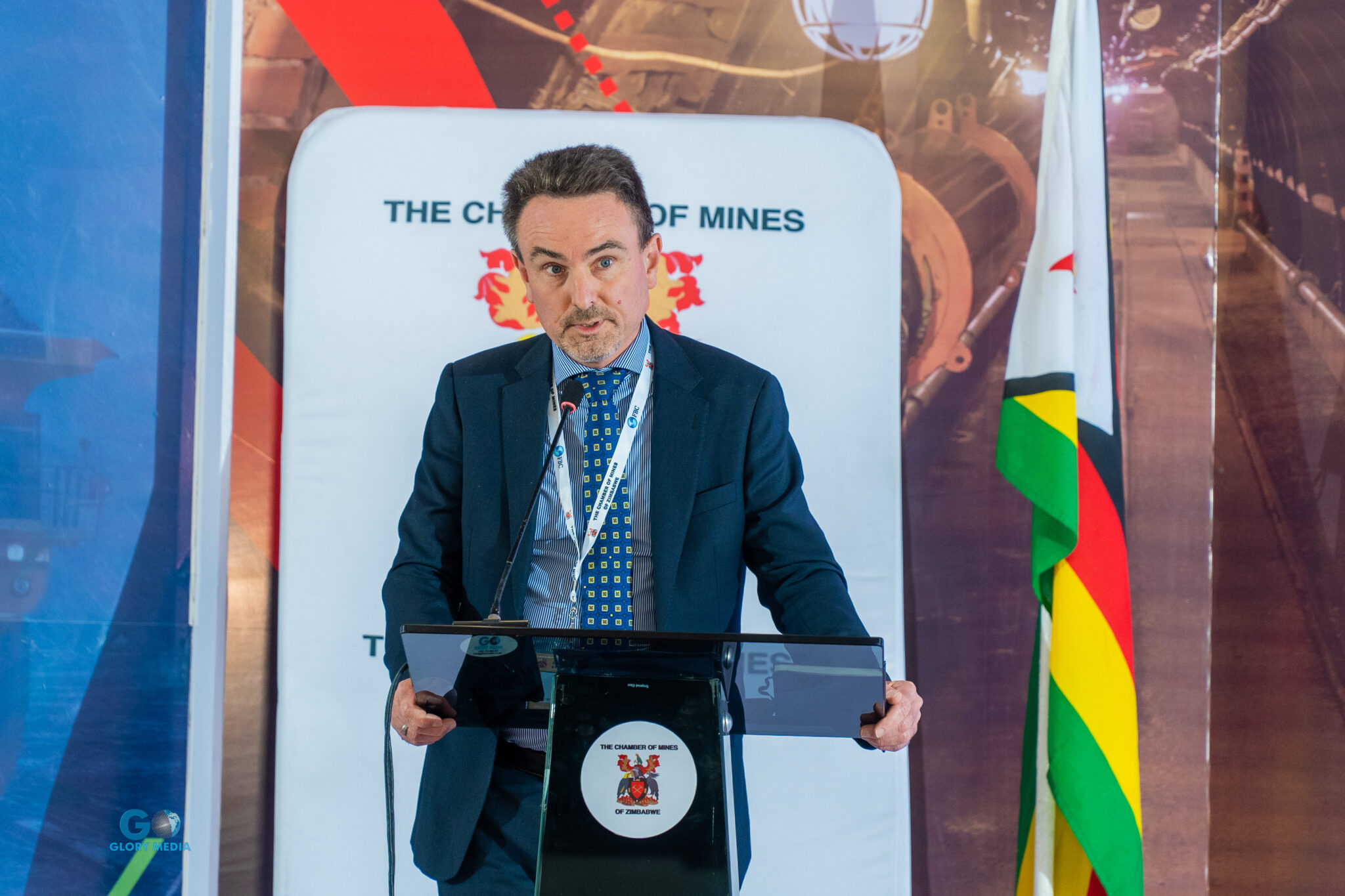
Exclusive interview with Geert Klok, Vice-President, Mozambique Chamber of Mines. At the upcoming Nigeria Mining Week, he is part of a session on industrialisation, titled “From Ore to Industry – Beneficiation & Refining.”
Interview Summary:
Geert Klok, Vice-President of the Mozambique Chamber of Mines and Vice-President of MIASA, highlights the importance of beneficiation for Africa’s mining future. Drawing on his experience with Mozambique’s Ancuabe graphite mine and giving South Africa’s Manganese Metal Company as an example, he stresses how value addition through processing creates jobs and industrial growth. He notes that beneficiation is driven by rising demand for critical minerals in renewable energy, batteries and defence, as well as geopolitical supply chain diversification. Africa’s challenge lies in moving from extraction to processing, which requires new skills, technology and competitive conditions.

Klok argues governments must provide stability, infrastructure and affordable electricity rather than relying solely on export bans. He cites Mozambique’s clinker plant as a model of local resource use and job creation. Regional cooperation, particularly within SADC, is essential to build viable supply chains for industries like EV batteries. His message at Nigeria Mining Week will emphasise competitiveness and gradual industrialisation.
Thank you for joining us. Let’s start with some background on you and your organisation.
Good day. My name is Geert Klok, and I’m Vice President of the Mining Industry Association of Southern Africa, also known by its acronym, MIASA. And MIASA is the umbrella organisation for the chambers of mines in SADC, where we meet, exchange information, share best practices, and help develop mining policies for the region.
I’m also on the board of directors of the Chamber of Mines of Mozambique. As a chamber in Southern Africa, of course, we’re a member of MIASA.
Professionally, my background is in graphite. I’ve been the country manager for AMG Mining in Mozambique for over a decade, and we opened a graphite mine in the north of Mozambique. And then I’m also a strategy advisor. So I help boards and excos with strategic decision-making in African countries.
Tell us more about the mining projects that you are involved in? Do you have any particular success that you can share?
As I mentioned, I’ve been involved with the Ancuabe graphite mine in Camp Delgado. That was a brownfield site which we renovated, both the mine and processing plant’s capacity were expanded to get back in production in 2017. The processing had by far the biggest number of employees. We had over 100 employees, even though the mine was on the smaller side. It was significant for the area, the biggest industrial employer in the district. So processing in terms of the crushing, milling, flotation to produce the graphite concentrate and also sieving. We had a sieving plant to separate the graphite according to flake size.
To give you another example, and this is in neighbouring South Africa, in Nelspruit in the Mbombela Municipality, just 100 km over the border from Mozambique. A company called the Manganese Metal Company produces EMM, which is electrolytic manganese metal. And that is a high purity form of manganese. They’re the only producer of EMM material outside of China, and they’re using a proprietary method that is selenium free. And that is quite significant because selenium is a toxic material that ideally you don’t want in your manganese. And it’s also an impurity. So, they’re the biggest producer of EMM selenium-free material. And they’ve just expanded into producing this material for the EV battery application. So that is quite a success story. They’ve focused on this high-end niche market.
So where the manganese smelters in South Africa have been going out of business, principally because of the high electricity prices, this company in Nelspruit has successfully focused on the premium market with their beneficiation plant.
Why is beneficiation becoming such an important topic for mining jurisdictions?
Beneficiation is a big topic at the moment for several reasons. For a number of years now, we’ve seen a lot of interest, especially in so-called critical minerals, sometimes called energy transition minerals, related to the energy transition going to renewables and the expected large increase in demand that that will require in terms of minerals for batteries, for storage, but also in terms of windmills and permanent magnets. Therefore, an expected dramatic increase in the need for those minerals.
And then also geopolitics, where more and more minerals are considered critical for defence applications and certain key industries like automotive. So where countries and blocks like the European Union, North America, but also Japan and Korea have defined what is critical for their economy and for their defence applications, the control over those minerals and diversification of the supply chains has become a big topic.
And then from the perspective of African countries, African countries have said, look, that’s first of all, a big opportunity. And we as African countries need to provide jobs. We need to provide development. We need to industrialise. So we can do that by beneficiation, by processing, keeping more of the value-add in country. So collectively, African countries have defined policies. For example, the African Union has already in 2009 defined the African Mining Vision. SADC has followed with the Regional Mining Vision.
The African Union has also defined their Green Mineral Strategy. So that is the current environment that we’re really looking at: how can beneficiation answer that increased demand for critical minerals? How can it answer the need for diversifying supply chains, and how can it help industrialise and bring further development to African countries?
What lessons can Africa learn from successful processing hubs around the world?
Processing hubs, apart from China, we’re looking, for example, at Indonesia. Indonesia has been to some extent a success story in the processing and the beneficiation of minerals, in particular, nickel. They are best known for banning the export of unprocessed minerals. But apart from that, they put in place an industrial policy that involved the creation of such processing hubs, where they put in the infrastructure, the power supply, but also fiscal incentives, and they were able to attract $44.5 billion of investments in a five-year period from 2020 to 2025. So that strategy has been very successful.
But on the flip side, what we can also learn from it is that there have been reports of massive environmental pollution coming out of Indonesia relating to those mineral processing hubs. On the one hand because they’re using coal-fired thermal power plants to provide the electricity for the processing, which is often very energy intensive. At the same time, in many cases processing will also require the use of large quantities of chemicals. So there have also been issues surrounding pollution related to chemicals coming into the environment. And I think that is a warning call for African countries, especially African countries that may struggle with the controls of their environmental legislation. If you bring in large-scale processing of minerals, you have to avoid that it becomes an environmental nightmare.
What challenges does the African mining industry face in moving from mining to processing?
Well, in terms of challenges for the mining industry, let me first make the point that not all mines are vertically integrated. So some mines are just mines. What they do is extracting the minerals from the ground. And not in all cases, the mines will go downstream and start processing and beneficiation. So if they would do that, they’re entering into a different industry, which might require different types of technology, human skills, know-how, and it will also change their sales and marketing. The client base might change substantially from when they are selling concentrate to when they are selling processed or advanced minerals for often very specific applications in different industries. So they would have to also upgrade their marketing and sales skills. So it may require quite a bit of adaptation and I believe that it’s not always as straightforward as one might think.
How can governments encourage investment into downstream industries?
I think it’s very important that we look beyond just legislation. What we’re seeing now is that governments are tempted to go the route, and some governments have gone down this route, of banning the exports of minimally processed minerals. But that in itself doesn’t create an industry, because in the end, it needs to be a business and it needs to be competitive.
What governments can do is to create the basic conditions, the foundation. That, first of all, is stability, legal stability, making sure that the rules of the game don’t change, because we’re talking about long-term investments and making investors comfortable with making those investments. And then also the general business environment and also perhaps tax incentives to help with the competitiveness.
Then we’re talking about physical infrastructure, roads, rail, ports, but also electricity. Electricity is key in terms of the availability, the quality, and of course, also the price. In many cases, the beneficiation requires large amounts of electricity. It’s a main cost driver for some of those industries like smelters. So it’s quite critical that the pricing is competitive.
That is not always the case, unfortunately, as the South African cases I mentioned earlier also demonstrate. So those are some of the basic conditions that I think governments should look at to create successful downstream beneficiation.
In your view, which minerals on the continent present the greatest beneficiation opportunities today?
I think if you talk about what are the biggest opportunities, first of all, we’re talking about size but also the chances of success. And I think the best opportunities have a combination of both using local resources and local minerals that are available and an in-country client base. So rather than having complex supply chains outside of the country, I think it is much more viable if you can sell to clients in-country.
To give you an example, last week our Mozambican President, Daniel Chapo, inaugurated an expanded cement factory in the north of Mozambique. This cement factory now includes a clinker plant. Before that, they were importing clinker. Now they’re going to produce it in-country, on-site, using limestone from a nearby quarry, and also using coal from Mozambique for the power generation for the clinker. And that reduces imports, so it reduces forex that was used to pay for those imports before, about $50 million according to news reports. And then job creation, they talk about 550 direct and indirect jobs added with this expansion of the plant and lower prices for the consumer. So that is ideal. And I think it’s a good example of, you know, both impact and a high viability of having that mix of factors of locally available materials, consumers within country, and also I should mention a relatively standard technology. The technology required for making clinkers is quite standardised, so readily available.
What is the role of regional cooperation in the development of downstream beneficiation?
In terms of regional cooperation, as I mentioned, we have the African Mining Vision and also the SADC Regional Mining Vision, which specifically call for cooperation between countries. And we have to keep in mind that some supply chains can be quite complex and may require a large scale that I think goes beyond what individual countries can bear or can justify. If you look at Mozambique’s population, it’s 35 million. Other countries in the region have even smaller populations. So if we look at a supply chain for batteries for electric vehicles, for example. These batteries take more or less 10 different minerals that typically you don’t find all in one country, but in the region, we have those 10 different minerals. So it would make sense to cooperate there. Plus that you need the volume and your supply chain needs to tie in with a consumer market or an end user market, for example South Africa, which has an automotive industry. So it would make sense to tie into the existing automotive industry in South Africa.
Regional cooperation would make a lot more sense than just every country in the region trying to go on their own and establish an EV battery supply chain for what are relatively small domestic markets, whereas SADC as a whole has about 380 million people. That’s a much bigger market that I think is more likely to justify the investments and also the scale requirements of a supply chain like the EV battery supply chain.
At the upcoming Nigeria Mining Week, you are part of a session on industrialisation, titled “From Ore to Industry – Beneficiation & Refining.” What will be your message at the event?
At Nigeria Mining Week, I will emphasise what I’ve been discussing here, namely that we should look beyond just legislation if we talk about policy. It’s not just banning the export of raw or minimally processed raw materials. We also need to create the conditions for our industry to be internationally competitive—if we’re part of a supply chain that crosses national borders. So that’s anywhere from the infrastructure that we’ve discussed and electricity, to the business environment, possibly also some tax incentives.
And that I think is really the key. Then also to go step by step and have a gradual approach where the industrialisation and the requirements are met by the rate at which the national capacity to support competitive industries can be sustained.
Any final thoughts from your side?
Beneficiation is very topical, and it’s great that it’s on the agenda of Nigeria Mining Week. It’s important that we discuss this and that we get it right as African countries. So I’m very much looking forward to the discussion in October in Abuja, Nigeria, and I hope to see you there. Thank you.