
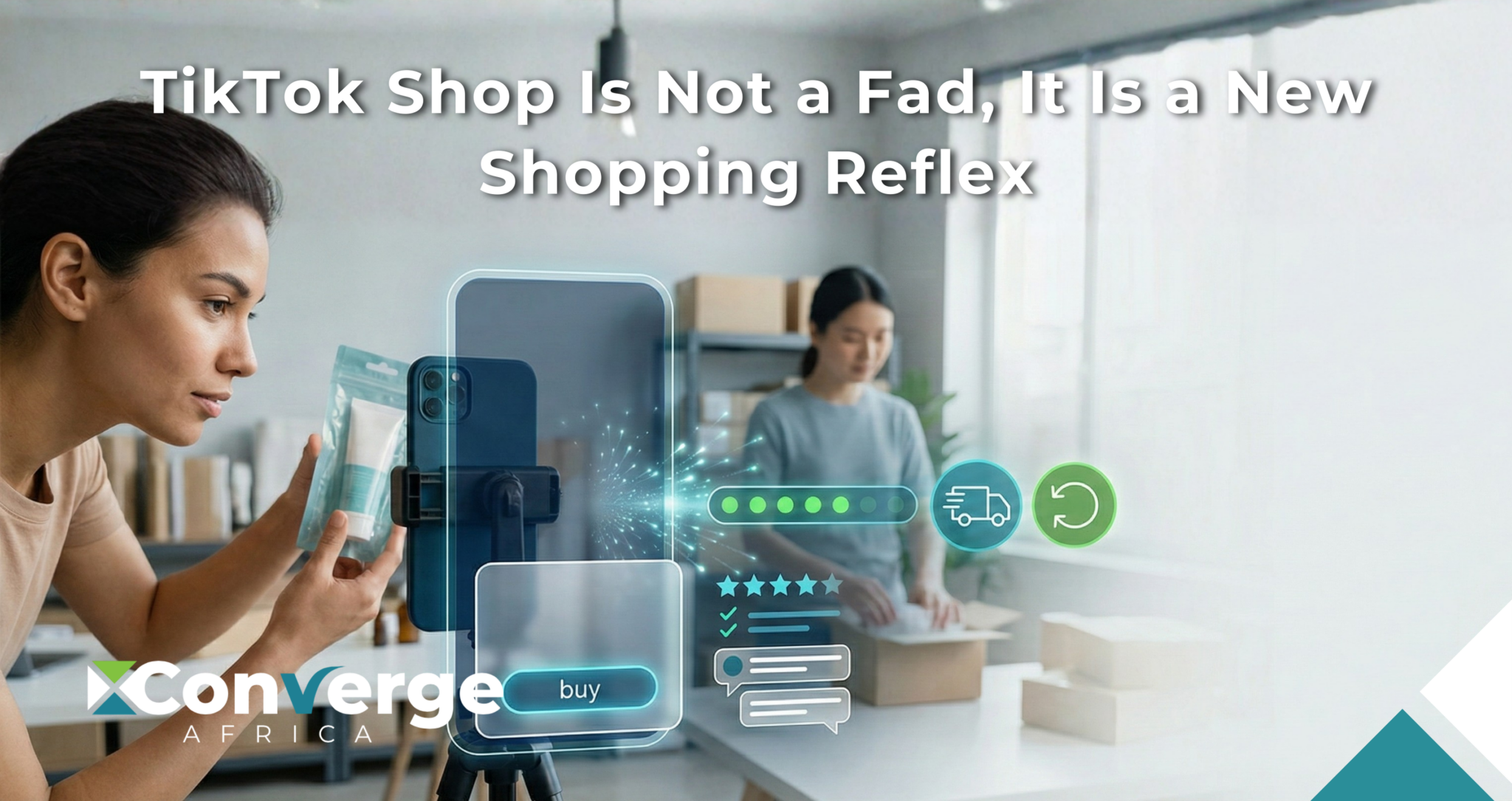
Many retailers still behave as though discovery begins with intent, a search query, a category browse, then a product comparison. That journey still exists, but it is no longer the only dominant path to purchase.
A growing share of shopping begins with exposure, a creator demo, a before-and-after, a “here’s what I bought” video, then a comment section that functions like a crowdsourced quality assurance panel. Retail’s old story assumes shoppers are primarily rational planners. The new reality is that shoppers are also cultural creatures, and culture is now one of the biggest distribution systems on earth.
The educator reframing is that social platforms are not merely marketing pipes, they are retail environments where the shelf is algorithmic and the signage is social proof. The “store layout” is the feed, and the “sales assistant” is the creator plus the comment section. People do not simply buy products, they buy validated decisions, meaning they buy when they feel the crowd has already tested the risk on their behalf.
That is why social commerce can accelerate trust quickly, but it can also accelerate disappointment brutally if delivery fails or quality is inconsistent. Social commerce is not just a top-of-funnel story, it is where purchasing intent is increasingly forged.
The numbers are crossing a psychological threshold. eMarketer projected US social commerce sales of about $87 billion in 2025, with 2026 expected to surpass $100 billion, and it noted TikTok Shop represents close to a fifth of US social commerce in 2025.
The point is not that South Africa will mirror US behaviour exactly, the point is that social commerce is proving it can scale into a mainstream buying behaviour. Once a behaviour becomes normal for a generation, retailers have to rebuild around it, because you do not out-market a structural shift in how people discover products.
Retailers keep thinking the problem is content output, more posts, more creator deals, more hype. The real bottleneck is operational readiness. Social commerce turns inventory accuracy into a public performance, and it turns fulfilment reliability into a reputation event. Viral demand is spiky, it punishes brittle systems, and it amplifies
failure in real time. A retailer can spend months crafting a brand story and destroy it in a weekend with missed deliveries, confusing returns, and slow support. Social commerce is a stress test disguised as a growth opportunity.
The lobbyist stance is that social should not be treated as a “channel” feeding the website, it should be treated as a shop surface that must connect to live inventory, frictionless mobile checkout, and fast resolution when something goes wrong.
Retailers need to stop celebrating reach and start measuring purchase reliability, because reliability is what creates repeat behaviour. If your brand can keep promises at social speed, you gain a compounding advantage. If you cannot, social becomes the loudest megaphone for your weakest processes.
Build commerce-ready content systems that connect to stock truth, simplify checkout for mobile behaviour, and design returns and customer support as part of the social experience, not as an afterthought. Build creator programmes that are measurable and repeatable, not purely personality-based. Most importantly, engineer your operations to survive sudden surges, because in social commerce the difference between a hit and a headache is often just whether your system can keep up with your own success.
 Contact Us
VUKA is the trusted media partner to key professionals, policy makers, suppliers and
manufacturers. We provide unparalleled opportunities for industry-wide connection.
