
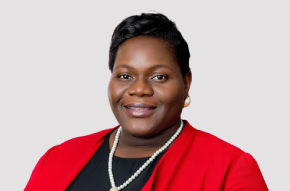
At the recent Enlit Africa in Cape Town, VUKA Group’s Green Economy Portfolio met up for an exclusive interview with Ms Ojuru Adeniji, VP, Origination & Structuring at InfraCredit in Nigeria and speaker at the conference.
Ms Ojuru Adeniji explains how InfraCredit provides local currency guarantees to unlock financing for infrastructure projects in Nigeria, particularly distributed renewable energy (DRE). With 45% of Nigerians lacking electricity, InfraCredit’s portfolio of 324 billion naira spans energy, healthcare, manufacturing and logistics. She highlights challenges such as weak project preparation and lack of standardisation, addressed through the DRIFT facility, which helps developers meet lenders’ criteria. Adeniji stresses equitable energy access, women’s growing role in the sector and guarantees as tools to de‑risk investment and drive resilience.
Thank you. I’m delighted to be here, and thank you for having me. I work for an infrastructure credit guarantee company. We are now a listed entity in Nigeria, and we focus on providing local currency guarantees that enable infrastructure projects to access finance.
Ordinarily, these projects might not secure financing, or they would have to do so at very high interest rates given the macroeconomic environment in the country.
InfraCredit provides local currency credit guarantees that unlock access to finance for transactions, project sponsors, and developers in Nigeria. This spans several eligible sectors, including distributed renewable energy (DRE).
Nigeria faces a major energy crisis: about 45% of our population does not have access to electricity. In the DRE space specifically, guarantees allow project sponsors to secure financing at reasonable interest rates.
Beyond energy, our portfolio covers manufacturing, healthcare, and gas. Most of what we do today has a tangible impact on individuals, companies, and the Nigerian economy at large.
Currently, we have a portfolio of 324 billion naira in guarantees across 22 companies, focused on energy access, infrastructure, transportation, and logistics.
This has had a significant impact on the Nigerian economy. InfraCredit has pioneered long-dated debt instruments, such as a 20‑year corporate bond—the first of its kind. We also supported one of Nigeria’s first green bonds, guaranteeing the NSP North South Power Project, a hydroelectric facility in Northern Nigeria. Once concessioned by the federal government but non‑functional, it is now operational thanks to the InfraCredit guarantee.
We have development partners, but our foundation rests on our capital providers, one of which is AFC, the Africa Finance Corporation. We were essentially set up by the NSIA, the Nigerian Sovereign Investment Authority.
Today, our capital providers include NSIA, AFC, and InfraCo Africa, alongside domestic institutional investors. They form the first pillar. Secondly, our development partners—such as KfW (the German state‑owned development bank) and AfDB—support us both as capital providers and risk‑sharing partners. They have been instrumental in financing projects and unlocking transactions in the local economy.
We also work with British International Investment and the UK Foreign, Commonwealth & Development Office (FCDO), who have played a key role in expanding access to finance in Nigeria’s DRE sector.
Challenges remain, particularly around project preparation and development. Many projects fail to meet lenders’ criteria, often due to weak structures or informal approaches by developers. This issue recurs across projects and weighs heavily on us.
We currently have a pipeline of over $600 million in DRE projects in Nigeria, but many cannot be closed because of these structural concerns. A major issue is the lack of standardisation. For example, banks in Nigeria request different sets of documents, even though they hold the same licence.
This highlights the need for financiers to clearly define requirements. To address this, we created the Distributed Renewable Energy Enhancement Facility (DRIFT), funded by KfW and the Global Energy Alliance for People and Planet (GEAPP), with support from the World Bank in shaping the framework.
We found about 40 DRE companies seeking finance, but many lacked proper organisation, documentation, governance, and institutional frameworks. DRIFT helps close these gaps by standardising procedures—such as site selection, community agreements, anchor load requirements, and staff training for mini‑grid deployment.
In summary, DRIFT is a project bankability engineering facility designed to prepare projects that meet lenders’ criteria and empower developers with the knowledge needed to access finance.
My session focuses on how guarantees de‑risk access to capital and investments, with specific examples from Nigeria. We will also explore how guarantees unlock finance more broadly. Importantly, guarantees do not make a bad project good; they enhance the value of a good project.
We will share real‑life examples that contributed to InfraCredit’s 324 billion naira in guarantees across 22 companies. We will also examine the challenges good projects face, how they accessed finance, and the governance structures that enabled credit delivery.
We touched on energy poverty earlier. What is your vision for universal electricity access for Africa?
My vision centres on equitable access to energy—ensuring electricity reaches unserved and underserved communities. This catalyses other industries and sectors across Africa.
For example, in one rural Nigerian community that had never had electricity, the arrival of power transformed daily life. Residents now enjoy access to refreshing cold water in the heat, small businesses have emerged, and women are running shops. Most importantly, children can study and prepare for exams with reliable electricity.
I believe Africa’s challenge is not just poverty, but energy poverty. Providing energy can eradicate poverty in communities and across the continent.
That’s an important question. Just before this interview, I was on a call discussing criteria for supporting women in business. I wanted to ensure women were included and given opportunities aligned with their capacity.
Yes, I am seeing more women in energy and at conferences. I strongly believe in the saying: when you educate one woman, you educate a community. This holds true in the energy space as well.
Bringing one woman into the sector brings a community—whether as business owners, social entrepreneurs, board members, or executives. I was given an opportunity as a woman, but it was not easy. It required fighting for every seat and owning the room.
I believe we will continue to see more women in energy, particularly in Africa, where their presence is vital.
 Contact Us
VUKA is the trusted media partner to key professionals, policy makers, suppliers and
manufacturers. We provide unparalleled opportunities for industry-wide connection.
