
Over the years, I’ve noticed something interesting.
Most organisations spend a great deal of time defining their customer promise, but very little time measuring whether customers actually experience that promise.
We measure response times. We measure service levels. We measure Net Promoter Score (NPS), Customer Satisfaction (CSAT) and customer effort. We build dashboards and review trends every month.
Yet we rarely stop to ask a much simpler question.
Did we actually deliver what we said we would?
I think that’s one of the biggest blind spots in customer experience today.
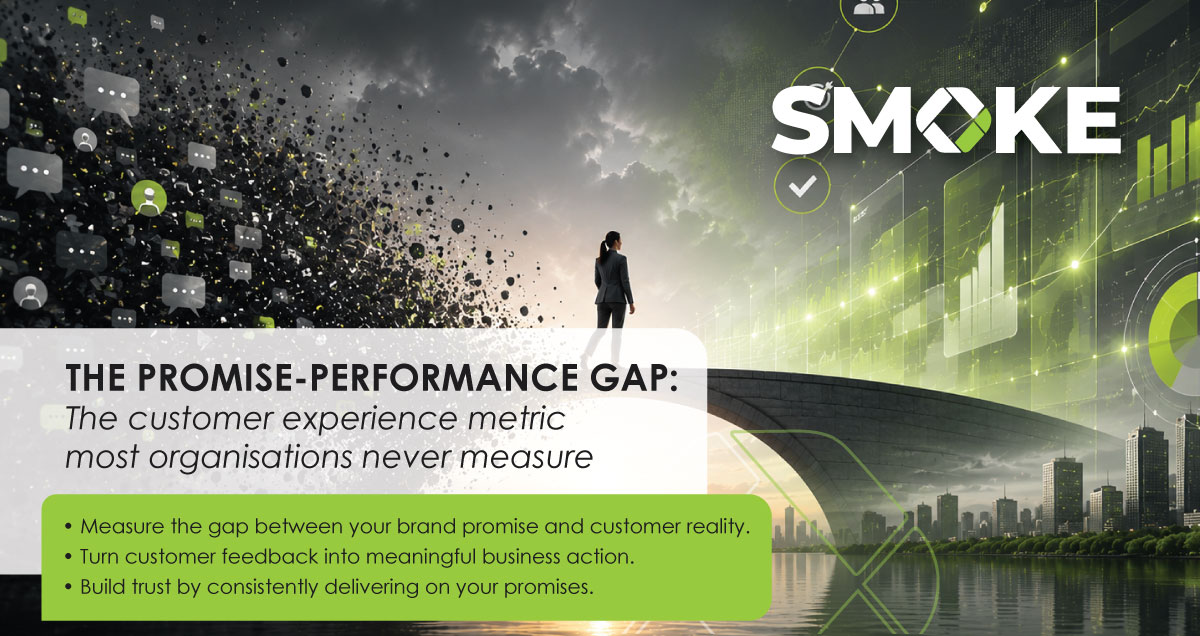
The promise-performance gap is the distance between what a brand tells customers to expect and what they actually experience.
It’s the difference between the advert and the reality. Between the sales pitch and the service. Between what appears on the website and what happens when a customer picks up the phone.
When that gap is small, trust grows. Customers know what to expect because the organisation consistently delivers on its promise.
When the gap widens, trust starts to erode.
We’ve all experienced it.
The bank that promises simplicity but requires three phone calls to solve a problem.
The retailer that advertises effortless returns before sending you through a complicated process.
The insurer that promises peace of mind until you need to submit a claim.
Very few organisations set out to disappoint customers. More often, the gap appears because different parts of the business are measuring different things. Marketing focuses on the promise. Operations focus on efficiency. Customer service focuses on resolution. Product focuses on delivery.
Meanwhile, the customer experiences the organisation as one brand.
ALSO READ: Why your customer experience is your biggest growth risk
Traditional CX programmes are excellent at measuring individual interactions.
Was the call helpful?
How satisfied were you with your visit?
Would you recommend us?
Those are all valuable questions, but they don’t tell us whether the organisation delivered on the promise it made.
A customer might rate a service interaction highly while still feeling that the organisation isn’t what it claimed to be. Equally, a customer might tolerate the occasional poor experience because the organisation consistently delivers on the things that matter most.
Looking only at transactional scores can sometimes make us feel more informed than we really are.
The question isn’t simply whether customers were satisfied.
It’s whether their experience matched the expectations we created.
In my experience, the promise-performance gap tends to show up in six areas.
Does the experience live up to the expectations created by your marketing and sales messages?
Does what you’ve delivered actually perform the way customers were led to expect?
Can customers interact with you in the ways you’ve promised, when they need to?
When something goes wrong, is it genuinely easy to resolve?
Do you communicate honestly, clearly and quickly, especially when things don’t go according to plan?
This is often the biggest one. An issue is acknowledged, a case is opened, and then nothing. No follow-up. No resolution. Silence. Customers don’t expect perfection, but they do expect someone to come back to them.
None of these gaps appear overnight. They develop gradually until they become accepted as “the way things are”.
I think there are three simple questions every leadership team should ask.
First, what does your organisation actually promise customers?
Not what’s written in the strategy document, but what customers hear in your advertising, on your website and from your sales teams.
Second, what does your customer feedback tell you people actually experience?
Not just the scores. The verbatim comments. The complaints. The compliments. The recurring themes.
Finally, where do those two stories differ?
If your organisation can’t answer that confidently, it probably doesn’t have a measurement problem.
It has a listening problem.
When organisations discover a promise-performance gap, the natural instinct is to fix it by doing more.
More training.
More reporting.
Another dashboard.
Another customer initiative.
Sometimes those things help.
Often they don’t.
Because if you haven’t identified which promise you’re breaking, you’re simply getting better at measuring disappointment.
The organisations that make real progress tend to do three things well.
They listen honestly by collecting feedback across the entire customer journey and spending as much time reading customer comments as they do reviewing scores.
They work to understand what they’re hearing by looking for patterns rather than isolated incidents, and by resisting the temptation to explain away uncomfortable feedback.
Then they act. They fix specific problems, close the loop with individual customers and measure whether trust is improving over time.
That’s where customer experience starts to become a business discipline rather than a reporting exercise.
Every organisation has a customer promise, whether they’ve written it down or not.
The real question is whether your customers would describe that promise in the same way you do.
If the answers don’t match, you’ve identified one of the most valuable opportunities your organisation has to improve.
Because customer experience isn’t ultimately about measuring interactions.
It’s about consistently delivering on the promises your brand has already made.
Shereen Rimmell has spent 30 years helping organisations close the gap between listening to their customers and actually doing something about it. As Chief Commercial Officer at Smoke Customer Intelligence, she works with leaders to embed customer and employee intelligence into decision-making, turning insight into measurable outcomes for customer loyalty, employee engagement and business performance. She will be participating in the workshop “From NPS to P&L: Getting CX Into the Boardroom” at CEM Africa 2026 on Wednesday 19 August.
READ NEXT: Why call centre CX belongs at the centre of CEM Africa 2026

 Contact Us
VUKA is the trusted media partner to key professionals, policy makers, suppliers and
manufacturers. We provide unparalleled opportunities for industry-wide connection.
