

Customer Experience is “hot” right now for a specific reason: leading analysts describe CX being replatformed by AI, with the entry point for service shifting away from company-owned channels towards third-party, conversational environments that customers already use. Gartner reports that more than half of customer service journeys now start on third-party platforms (search engines, social platforms, and genAI tools), changing how organisations must show up, publish knowledge, and preserve context.
At the same time, global CX quality is not rising in step with these expectations. Forrester’s latest Global Customer Experience Index findings describe a multi-year erosion in CX quality worldwide, with declines linked to weaker employee experience, disappointing tech implementations, and economic volatility.
This creates the central awareness theme highlighted by multiple sources: organisations are under intense pressure to deploy AI in customer service, yet the hardest work is operational and foundational (knowledge quality, data coherence, workforce design, and security). Forrester explicitly predicts that service quality will dip as companies wrestle with AI deployment complexity and change management, even as self-service improves for some.
Zooming in, Africa’s CX conversation cannot be separated from mobile infrastructure, smartphone affordability, and digital skills. GSMA reports a 60% mobile internet usage gap in Sub-Saharan Africa, with affordability and limited digital skills cited as key barriers.
South Africa then adds two further layers: fast digital commerce growth (with a rapidly rising online retail share) and a documented “reality gap” between what businesses believe customers feel and what consumers report.
A pivotal global pattern is the relocation of the customer service “front door” from first-party channels to third-party platforms and assistants. Gartner’s customer survey found that 51% of service journeys begin on third-party platforms (including search engines and platforms such as YouTube and Reddit), and that this behaviour is even more pronounced for Gen Z customers.
Gartner’s data also quantifies why this shift matters operationally: customers reported a 62% success rate finding what they need on third-party platforms, while only 22% start, stay, and resolve issues entirely within first-party company channels. Interpreted through Gartner’s framing, customers are choosing “low-effort” paths and will increasingly bypass traditional channel strategies unless companies adapt how they publish and structure support information.
The forecast horizon reinforces why this topic is dominating boardroom attention. Gartner predicts that by 2028, 70% of customer service journeys will begin and be resolved in conversational, third-party assistants built into mobile devices.
In the same set of predictions, Gartner also forecasts that 30% of Fortune 500 companies will offer service only through a single, AI-enabled channel by 2028, explicitly associating this with the rising complexity and cost of multichannel journeys.
These are not just interface predictions. They imply a strategic change in what “omnichannel” means. Gartner argues for a pivot from convoluted omnichannel approaches towards “omni-modal” strategies, where customers communicate through one digital channel using their preferred mode (text, voice, video, image).
The heat in the topic is coming from a convergence of urgency, customer behaviour shifts, and uneven outcomes.
First, Gartner’s February customer service survey reports that 91% of service and support leaders feel pressure from executive leadership to implement AI, with leaders citing customer satisfaction, operational efficiency, and self-service success as top priorities. Gartner also reports that leaders are looking to AI to support first-contact resolution, reduce customer effort, and guide customers through more seamless journeys.
Second, Forrester’s Global CX Index reporting frames a global performance context that makes this urgency sharper. Forrester reports that globally, 21% of brands declined in CX quality, 6% improved, and 73% were statistically unchanged in its 2025 rankings. Forrester explicitly links the decline to ongoing challenges including weaker employee experience, waning customer obsession, disappointing tech implementations, and economic volatility, while noting that the intent-to-deliver versus lived-experience gap is widening.
Third, Forrester’s analyst commentary in the same release underscores the commercial stakes of small CX shifts: the firm states that even minor improvements to CX quality can reduce churn and increase share of wallet, in the context of declining loyalty. This is consistent with McKinsey & Company’s experience-led growth argument that CX improvements should be tied to financial outcomes such as share of wallet, repeat purchases, and net revenue retention.
McKinsey’s published analysis adds a reason CX becomes a CEO-level priority in turbulent markets: it argues that CX leaders achieved more than double the revenue growth of CX laggards between 2016 and 2021 (US example), and that losing one customer can require acquiring three new customers to compensate for the value lost. The implication McKinsey draws is that existing customers, retention, and experience-driven value are strategic levers when acquisition gets costly.
Multiple sources describe an important correction: AI-first CX is not primarily a tooling story. It is an operating model story.
Forrester’s customer service predictions argue that the coming period will be defined by “gritty, foundational work” rather than dazzling transformation, because scaling AI reveals operational gaps. Forrester explicitly predicts that service quality will dip as companies wrestle with deployment complexity and robust change management.
The same Forrester analysis provides quantified forecasts that illustrate both upside and strain. Forrester predicts that one in four brands will see a 10% increase in successful simple
self-service interactions by the end of 2026, linking this to growing trust in genAI outputs among AI decision-makers. In parallel, Forrester predicts new load problems: it expects consumer-developed AI agents to create “call volume spikes” that can resemble denial-of-service impacts, driving demand for bot and agent management solutions.
Crucially, both Gartner and Forrester tie this to workforce and knowledge design, which is where continuity and “organisational memory” become operationally concrete.
Gartner reports that nearly 80% of organisations plan to transition at least some agents into new roles, and that 84% plan to add new skills to the agent role and adjust hiring profiles. Gartner also reports a knowledge management emphasis, stating that 58% of service leaders aim to upskill agents into knowledge management specialists to support accurate, continually updated content for both AI systems and customer self-service.
Forrester’s prediction set reinforces the same dependency chain: it states that organisations will need to simplify tech stacks, consolidate vendor relationships, rework outdated processes, and invest in enterprise data quality and knowledge bases. Taken together, Gartner’s and Forrester’s published insights position “memory” not as a metaphor but as capability: the ability to preserve context across channels, keep knowledge current, and deliver consistent answers whether the customer arrives via a brand’s own channel or a third-party assistant.
The African CX environment turns global trends into sharper design constraints, because digital engagement is fundamentally mediated by mobile access, device affordability, and connectivity quality.
GSMA reports that by the end of 2023, nearly 44% of the population in Sub-Saharan Africa subscribed to a mobile service (527 million subscribers), while mobile internet penetration reached 27%. Despite that progress, GSMA reports a 60% mobile internet usage gap, and explicitly identifies affordability (particularly smartphone cost) and limited digital skills as major barriers.
This is why the “front door” shift to conversational interfaces matters especially in African contexts: conversational entry points often reduce navigation complexity, but only if knowledge, language design, and authentication are usable in low-bandwidth realities. GSMA’s reporting on AI adoption in the region notes that mobile operators are gradually adopting generative AI, focusing on customer service, network optimisation, and operational efficiency, while also facing challenges including skills shortages and data privacy concerns.
GSMA provides concrete regional case evidence of genAI being applied to customer service and continuity: it reports that MTN launched an AI-powered chatbot (“Zigi”) in December 2023 across countries including Nigeria and South Africa, then upgraded it in 2024 to handle more complex customer-service tasks and integrated it with billing systems for real-time account updates. (GSMA presents this as an example of AI-driven assistants handling inquiries, reducing waiting times, and improving customer satisfaction.)
On the inclusion side, Reuters reports on a GSMA-led coalition to boost smartphone access in poorer countries, explicitly citing smartphone cost as a barrier and positioning the “usage gap” as a multi-stakeholder inclusion challenge. This matters for CX leaders because it frames digital CX uptake as partially dependent on ecosystem interventions that sit outside individual brands.
On the trust rail side, GSMA’s reporting highlights that early API launches under its Open Gateway work have focused on fraud prevention and security, including APIs such as Number Verification and SIM Swap, framing these as “easy wins” given persistent fraud risks. In experience terms, these capabilities directly shape authentication friction, account security, and customer confidence in digital channels.
South Africa surfaces two intertwined CX dynamics: fast-growing digital commerce expectations and a documented gap between business perceptions and lived consumer experience.
The publication The 2024 South African Customer Experience Report reports that the highest level of unhappiness was in the public sector, where 62% expressed dissatisfaction or neutrality. It also reports frustration in “considered purchase” sectors such as automotive, insurance, healthcare and DIY, where ambivalence or dissatisfaction ranged from 39% to 45%.
The report then highlights an insight that is operationally relevant for CX leaders: it states that 88% of the businesses surveyed believed their customers were satisfied, while the consumer view in the report indicates more mixed sentiment. The report frames this as a “disconnect” and contrasts the value of face-to-face interaction with reliance on emailed NPS surveys, attributing that provocation to report author commentary.
The same report also discusses the homogenisation of CX and the scarcity of standout moments, quantifying that only 19% of surveyed businesses spend more time integrating moments of delight than fixing problems, while 49% spend more time focusing on known pain points. In the report’s framing, this suggests many brands are competing on functional fixes rather than distinctive connection.
Against that sentiment backdrop, South Africa’s digital commerce acceleration is clearly documented in primary research.
Mastercard’s report Online Retail in South Africa states that e-commerce rose to 6% of retail turnover by 2023 (R71 billion), expanded by 35% in 2024 to an estimated R96 billion (8% of total retail), and that trajectories indicate online sales surpassing R130 billion and approaching 10% of the national market by end-2025. The same report links participation and adoption to trust, noting that barriers to offshore adoption include trust and that consumers report differential trust between local and international platforms.
The Mastercard report also provides a useful proxy for “AI awareness-to-use” in consumer commerce: it reports awareness of artificial intelligence in online shopping at 60%, while active use remains limited to “just over a quarter” of consumers. That gap is meaningful for CX design because it suggests that AI-driven journeys must remain legible and optional for many customers, rather than assuming broad AI fluency.
South African benchmark signals on trust and emotional connection are visible in industry indices. In communications about the Orange Index awards, Ask Afrika reporting is cited by Discovery Bank in stating that the bank placed first across emotional connection, relationship building, humanness, client trust and brand advocacy (and ranked highly for authenticity in the referenced study context). This illustrates how “trust and relationship” are measured and rewarded in high-performing local brands, at least within that index’s methodology and sample.
South African case evidence also shows how CX strategies adapt to uneven digital confidence. Reuters reports that Takealot expanded into townships and rural areas by hiring personal shoppers to assist mostly non-tech-savvy consumers, positioning the move as part of competing with global entrants and widening access. (Reuters also reports a goal of growing these personal shoppers further by the end of the decade, framing this as a scaled model to reach underserved segments.)
| Lens | What is changing most | Opportunities highlighted in current evidence | Challenges and risks highlighted in current evidence |
| Global | Service journeys increasingly begin on third-party platforms and are forecast to move towards conversational assistants and fewer, more integrated AI-enabled channels. | Higher self-service success (for some brands) and potential efficiency gains through AI-human tandem operating models; quantified upside for existing-customer growth when CX improves. | Declining or stagnating CX quality; operational gaps exposed by AI; AI maturity limits; rising fraud and bot/agent traffic risks; workforce redesign and knowledge demands. |
| Africa | AI-first CX is constrained by mobile access realities: connectivity, smartphone affordability, and skills shape adoption and channel strategy. | Conversational interfaces and AI assistants can reduce effort and support inclusion when paired with usable channels and strong trust rails; network APIs can support authentication and fraud mitigation. | Large usage gap; affordability and digital skills barriers; AI skills shortages and data privacy concerns; trust and identity challenges. |
| South Africa | Digital commerce expectations are rising quickly while consumer sentiment data shows sectoral dissatisfaction and a business-to-consumer perception gap. | Strong growth in online retail and multi-channel commerce; measurable competitive advantage for brands recognised on trust and emotional connection; hybrid models (human help plus digital) can widen reach. | Public-sector and considered-purchase dissatisfaction; homogenised experiences; uneven digital confidence; trust and fraud vigilance; execution gaps between intent and lived experience. |
Table evidence base: Gartner customer journey and conversational AI forecasts; Forrester CX Index and customer service predictions; McKinsey CX-to-growth analysis; GSMA Mobile Economy reporting on usage gaps, AI adoption, and Open Gateway; Mastercard’s Online Retail in South Africa research; Reuters case reporting; Ask Afrika/Discovery Bank Orange Index communications; and The South African Customer Experience Report.
Measurable KPIs explicitly emphasised by the primary sources
Analyst and report sources cluster measurement around three categories: experience outcomes, operational performance, and trust integrity.
Forrester’s CX Index methodology is explicitly built on three CX dimensions: effectiveness, ease, and emotion, and frames CX quality as a loyalty-strengthening measure, with revenue relevance through reduced churn and increased share of wallet.
Gartner’s service leadership research highlights priorities and KPIs including customer satisfaction, operational efficiency, self-service success, first-contact resolution, and measuring and reducing customer effort. Gartner’s customer survey data also offers benchmark-style metrics that teams can compare against, including third-party self-service success rate (62%) and “start, stay, resolve” success in first-party channels (22%).
McKinsey frames CX metrics through financial behaviour change, emphasising share of wallet, repeat purchases, and net revenue retention as measurable outcomes tied to experience-led growth, alongside correlations between CX leadership and revenue growth.
Security and trust measurement is positioned as rising in importance: Gartner predicts a 300% increase in fraud attempts by 2027 (versus 2023 levels) impacting service organisations, while GSMA’s Open Gateway reporting highlights API families explicitly aimed at anti-fraud and user authentication (for example SIM Swap and Number Verification).
Charts to visualise adoption and impact

Timeline basis: Gartner press releases on conversational AI channel forecasts and fraud; Gartner survey on third-party starting points; Forrester CX Index rankings and predictions for customer service operations.
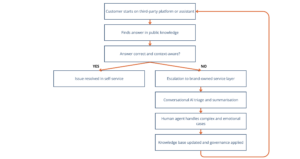
Flow interpretation basis: Gartner’s “third-party as front door” data and emphasis on accessible public knowledge; Forrester’s focus on knowledge bases, data quality, and AI-human tandem models; Gartner’s workforce and knowledge-management shifts.
 Contact Us
VUKA is the trusted media partner to key professionals, policy makers, suppliers and
manufacturers. We provide unparalleled opportunities for industry-wide connection.
