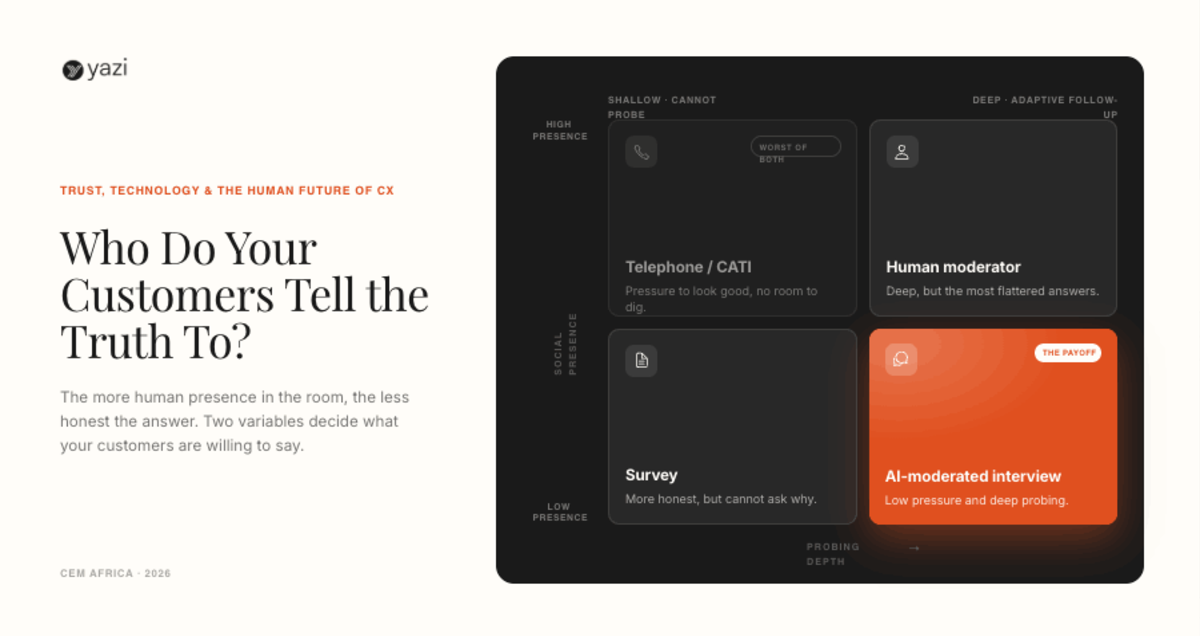
Every customer experience programme is built on an assumption that is almost never tested: that when a customer answers a question, they are telling the truth.
Not lying, exactly. But being accurate about what they think, what they feel, and what they will actually do.
The research on this is uncomfortable.
People shade their answers depending on who is asking, they conceal the things they are least proud of, and even when they are being entirely sincere, what they say they will do is a poor predictor of what they do.
For a discipline built on listening, that is a problem worth confronting directly.
The instinct in customer research has always been that a warm human being gets the best answers. Build rapport, make people comfortable, and they will open up. It is intuitive, and on the specific question of honesty, the evidence contradicts it.
Decades of methodological research on what is called social desirability bias points one way. Self-administered questionnaires consistently produce fewer socially flattering answers than interviewer-administered ones.
In a review of nine separate mode experiments on self-reported illicit drug use, every single one found higher reporting when there was no interviewer present.
The mechanism is simple. When another person is in the room or on the line, impression management switches on. The respondent is no longer just answering a question, they are managing how they are seen.
The effect is strongest exactly where it matters most. A study of young Australians, drawing on two national samples of more than 10,000 people, compared interviewer-assisted and self-report modes.
Participants reported lower psychological distress and higher wellbeing when a human was asking. On the non-sensitive questions, such as physical activity, there was no difference at all.
Read that again, because it is the whole argument in miniature. People concealed their distress from the interviewer, and only from the interviewer, and only on the questions that carried a hint of stigma.
The human presence did not build enough trust to unlock the truth. It suppressed it.
For any brand researching money worries, debt, health, addiction, discrimination, service failure, or anything a customer might feel embarrassed about, this is not a footnote. It is the central design decision of the study.
ALSO READ: Why your customer experience is your biggest growth risk
Social desirability explains the answers people give when they know the truth and choose not to say it. The say-do gap is more unsettling, because it appears even when people are being completely sincere.
Around 65% of consumers say they want to buy from purpose-driven, sustainable brands. Roughly 26% actually do. Around 38% of online shoppers do not follow through on behaviour they previously stated.
Analysts have put the predictive accuracy of traditional stated-preference research on actual purchasing at roughly a third.
The reason is not deceit. People are simply poor witnesses to their own motives. Asked why they chose a product, they introspect on processes they cannot actually observe and produce a plausible, tidy, rational story.
Asked what they will do next, they describe an aspirational future self who is better organised and more virtuous than the one who will actually be standing in the aisle.
The UK pensions body Nest ran a clean test of this: it used an online survey to identify the messages most likely to reduce opt-outs, deployed them in a live randomised trial, and found the opt-out rate did not improve. It got worse.
This is why a high response rate on a well-designed survey can still send a business confidently in the wrong direction.
Put those two findings together and the choice of method resolves into two questions, not one.
Is someone watching? The more human presence, the more impression management, and the less honest the answer on anything sensitive.
Can the method ask the unplanned follow-up? Without it, you get the answer but never the reason behind it, and no way to test a stated intention against actual behaviour.
Most methods force a trade between the two. Mapping them makes the trade visible.
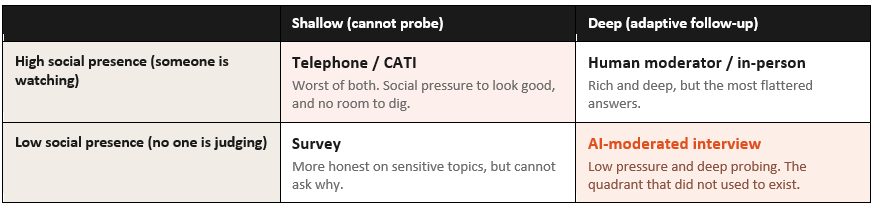
The quadrant that should worry the industry most is the top left. Telephone research combines maximum social pressure with minimum ability to probe.
It inherits the honesty penalty of a human interviewer without the depth that would justify it, and it does so at the moment when telephone response rates have collapsed from around 36% in the late 1990s to single digits today.
It is a method that is expensive, hard to fill, and structurally biased toward flattering answers.
The bottom right is the one that did not exist five years ago.
An AI-moderated interview has no social presence to speak of, no eye contact, no perceptible judgement, no impatience, and yet it can follow up, rephrase, and dig, in the respondent’s own words, at survey scale.
The claim only matters if people really do open up to a machine. Two independent findings suggest they do.
A controlled study that measured not just what participants said but their facial expressions, skin conductance and heart rate found people were equally willing to disclose personal information to an AI interviewer as to a human one.
Human interviewers built a stronger emotional connection. That warmth did not convert into more disclosure. Rapport and truth came apart again.
Separately, NORC at the University of Chicago randomly assigned 1,800 participants to either a standard questionnaire or a conversational AI agent that probed for elaboration on open-ended answers.
The AI version produced more detailed and more informative responses. Adaptive probing does not just get more words, it gets better ones.
Commercial figures point the same way, more dramatically, with vendors reporting substantially longer answers and higher completion in AI interviews than in surveys.
Those are self-reported and should be treated as directional rather than settled. The independent work is what carries the argument.
There is a plausible reason people speak freely to a machine, and it is slightly bleak: an AI cannot judge you, cannot gossip about you, and has no visible reaction to disappoint.
For a customer admitting they cannot afford the product, or that they have been struggling, or that they lied on a previous form, the absence of a human witness is a feature.
The practical takeaway is not that one method wins. It is that the method should be chosen against the sensitivity of the question, which is rarely how the decision actually gets made.
For sensitive, stigmatised, financial, health or wellbeing topics, reduce the human presence.
An interviewer will cost you the truth. For genuinely exploratory work, ethnography, delicate co-creation or senior B2B relationships, keep the human, because rapport is the point and the topic is not one people hide.
Ask what people did, not what they will do. Anchor questions in specific recent behaviour rather than hypothetical futures, and wherever possible validate stated preference against a behavioural or transactional record before betting a budget on it.
The single most valuable question in customer research is the second one. If your method cannot ask why, you are collecting positions rather than reasons, and positions do not tell you what to change.
Map your active research onto the two axes above. If most of it sits in the shallow half, you have a lot of data about what customers think and very little about why. If most of it sits in the high-presence half and covers sensitive ground, assume your numbers are flattering you.
It would be neat to conclude that technology beats people. That is not what the evidence says, and it is worth being precise about the distinction.
Humans remain better at connection. The research is clear on that too, and there is real work, sensitive, exploratory, relational, where a skilled human moderator is not just preferable but the only responsible option.
What the evidence unsettles is the assumption that connection and candour are the same thing. They are not, and for twenty years the industry has been quietly paying for the confusion.
The more useful reading of the human future of CX is this. Technology is not replacing the human in the conversation. It is removing the audience. And it turns out that for a great many customers, the reason they were not telling the truth was that someone was listening.
About the author
Yazi Research runs AI-moderated interviews, surveys and diary studies natively on WhatsApp across more than 15 African and emerging markets.
READ NEXT: Siloed thinking is limiting your customer experience – how to improve CX

 Contact Us
VUKA is the trusted media partner to key professionals, policy makers, suppliers and
manufacturers. We provide unparalleled opportunities for industry-wide connection.