
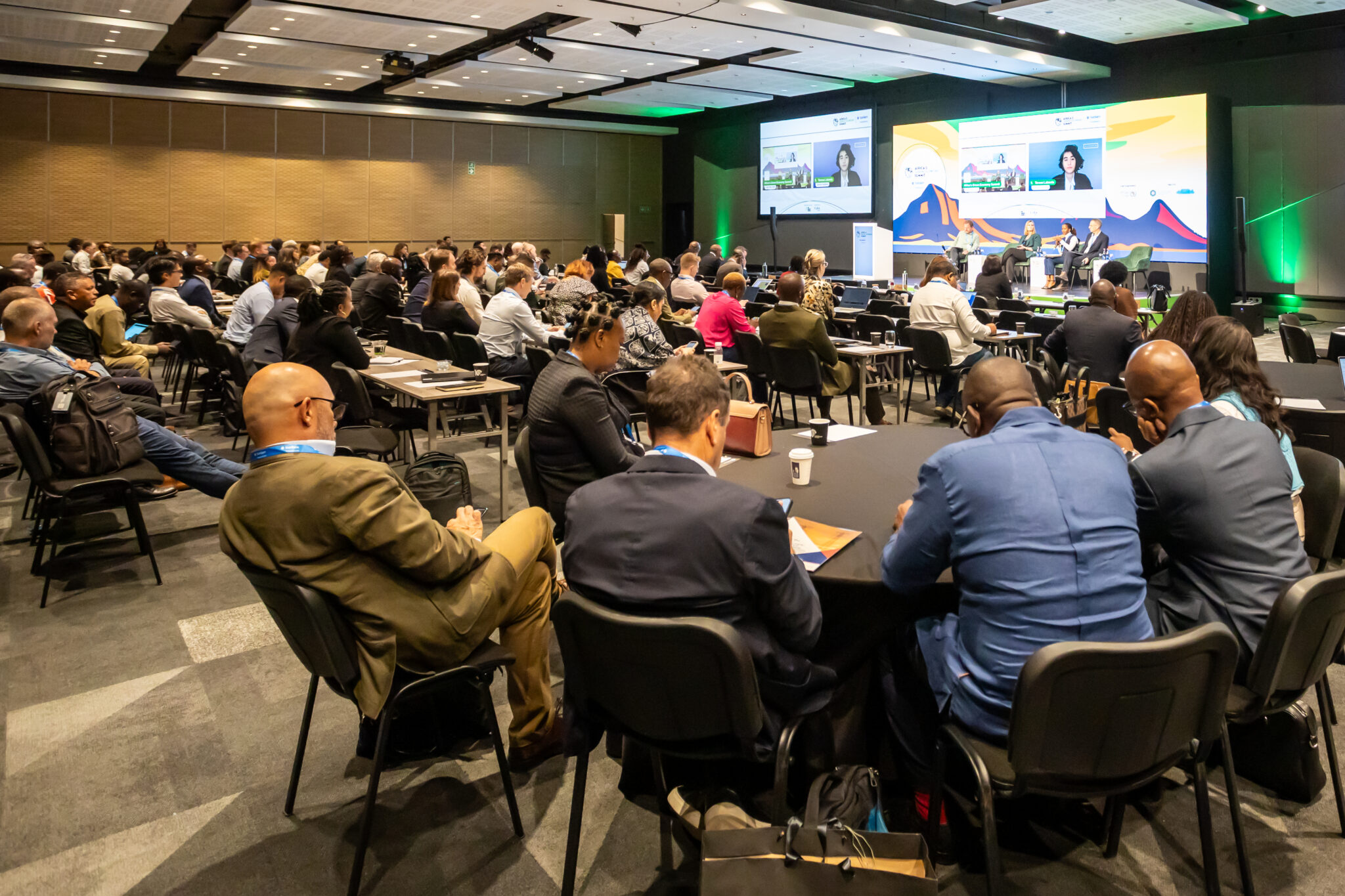
“It’s very clear that Africa has a huge opportunity in terms of a green economic growth transition,” said Dr John Roome, Independent Senior Adviser on Climate Change, Sustainable Development and Infrastructure and former World Bank climate change pioneer, at the closing session of Africa’s Green Economy Summit (AGES), which took place in Cape Town this week.
It has become an AGES tradition for Dr Roome, who chairs the event’s advisory board, to address the closing session with the main takeaways of the event: “By green economic growth transition we don’t only mean being worried about climate and environment, but also figuring out how one can drive economic growth and poverty reduction in a way that is climate smart, environmentally responsive and addresses poverty at the same time.”
He continued: “We had rich discussions with a large number of participants, and, at the same time, we’ve seen lots of really good examples of things that are going well in Africa, and there’s a real chance for Africa to have an incredibly bright future. But to do this is going to require very strong collaboration between policymakers, project developers and financiers in a very integrated way. And we started this process of bringing everybody together here at AGES. What we’re trying to in the future is to deepen this collaboration on an ongoing basis. So we’re not only focusing on the annual AGES event, but we’re working together to build a community of practice during the year to try and drive this agenda.”
Building skills
Earlier, during the AGES Day 2 opening session with the theme of “Building Skills for Africa’s Green Transition,” Maxwell Gomera, Resident Representative of UNDP South Africa and Director of the Africa Sustainable Finance Hub, Africa Region stated that “skills are at the core of the transition. Without the right skills, we’re not going to get very far. And we are not doing as well as we should at the moment.”
He mentioned that China trained an estimated 1.4 million engineers per year while there were less than 100 000 across the African continent that qualified annually. “You can see the skills gap is huge. Europe is doing a little bit better with a couple of hundred thousand, but still, we are nowhere near where we need to be. So we need to think about how we start to train a new cadre of entrepreneurs and young people who have skillsets that match the green economy.”
Not a skills issue
The panel discussion that followed focused on what Africa needs to do to maximise the number of jobs created by the shift to the new green economy and how it should build the skills and capacity to take advantage of this opportunity?
The audience heard that the new economy would create jobs mainly in the energy, agriculture and construction sectors. In addition, it was not just about “job creation, but large-scale reskilling” according to Teresa Labonia, Director at Systemiq in France.
Further challenges included that current training systems still prioritised theory over much-needed experience in green businesses. The future green employee will also increasingly need “hybrid skills” instead of narrowly focused education.
However, Anthony Gewer, Senior Programme Manager, Economic Inclusion at the National Business Initiative insisted that it is “not a skills issue, it is a job issue.” He added that the informal sector of the South African economy was an important employer and that “we are not creating enough jobs there.”
“Carpe Digital”
During the session entitled “Smart, Green, Connected: Africa’s Climate Tech Opportunity,” that examined the fast-converging digital and climate agendas, the audience heard that Africa must “carpe digital” or “seize the digital” to unlock its climate ambitions, as investors, policymakers and technologists discussed how the continent’s data boom can accelerate—rather than derail—the green transition.
Siddhartha Raja, Senior Digital Specialist at the World Bank, said digital infrastructure investments must be shaped by long-term policy thinking to ensure they deliver both climate and development gains.
He argued that large-scale assets such as data centres and telecommunications networks could serve as “anchor loads” within national power systems, helping to crowd in renewable energy generation.
“Are we able to leverage that into investments, for example, in renewable energy that are being made by the energy suppliers and the generators?” Raja asked.
Right policies to ensure investors
“We’re seeing changes and developments in the climate space,” was the opinion of fellow panellist OluwaKemi Olajide, Principal at Africa Climate Ventures in Nigeria, “and to drive scale and unlock growth, one of the key things that will be driving technology forward is really the investments into the space.”
She added: “It is very important for all players to work together, both the government from the policy front, the investors who are already deploying private capital into these companies, and the pension fund managers and other institutional fund managers who are typically safe in how they invest. They need to take a little bit more risk to come in and just build the right kind of capital stack to de-risk a lot of the opportunities that we’re seeing in the space so that we can catalyse both.”
Africa’s water crisis
Water may appear to be a daunting proposition for investors—it is poorly structured, underprepared and trapped in weak partnerships—but it is about understanding the risk (perceived or otherwise) and how it is placed and ultimately addressed.
This was the key message from an expert panel that tackled the topic, “Financing Water: Turning Risk into Opportunity” and argued that Africa’s water crisis could become its next green asset class – if governance, data and financial design are fixed.
Panellist Obadiah Mungai, Environmental Finance Lead for Cities at World Resources Institute Africa rejected the idea that hydrology alone makes water un-bankable: “Yes, there are droughts and floods. But the investability problem is one of translation … how do you convert water outcomes into bankable outputs?”
He pointed to structural weaknesses rather than climate volatility. In South Africa, non-revenue water—estimated at more than 40%—reflects failures in billing, metering and collection rather than rainfall patterns.
 Contact Us
VUKA is the trusted media partner to key professionals, policy makers, suppliers and
manufacturers. We provide unparalleled opportunities for industry-wide connection.
