INSIGHTS FROM FSD AFRICA REPORT:
· Local Benefits Vary: Clean energy and cookstove projects deliver stronger economic and health outcomes than forest-only projects.
· Limited Job Creation: Projects create some jobs, but impact is often small and unevenly distributed.
· Revenue Sharing is Modest: Communities receive limited and delayed income, especially when costs are high.
· Gender & Equity Gaps: Women often excluded from benefits due to land and power imbalances.
· Health & Environmental Gains: Notable in projects like clean cookstoves and waste management.
· Design & Governance Matter: Community-led, well-structured projects deliver better results.
VIEW THE REPORT HERE
POLL QUESTION AND RESULTS:
· A poll asked participants to rank top co-benefits for African carbon projects: options included jobs, livelihoods, biodiversity, water, health, equity, or “all equally important.
· Results showed strong support for biodiversity, job creation, and “all equally important.
· Panelists agreed that prioritization is necessary due to limited resources and varying project types.
· Community voices must drive decisions—what communities value may differ from assumptions by outsiders.
· From a policy perspective, job creation and ecosystem health are often top priorities.

INSIGHTS FROM SPEAKERS:
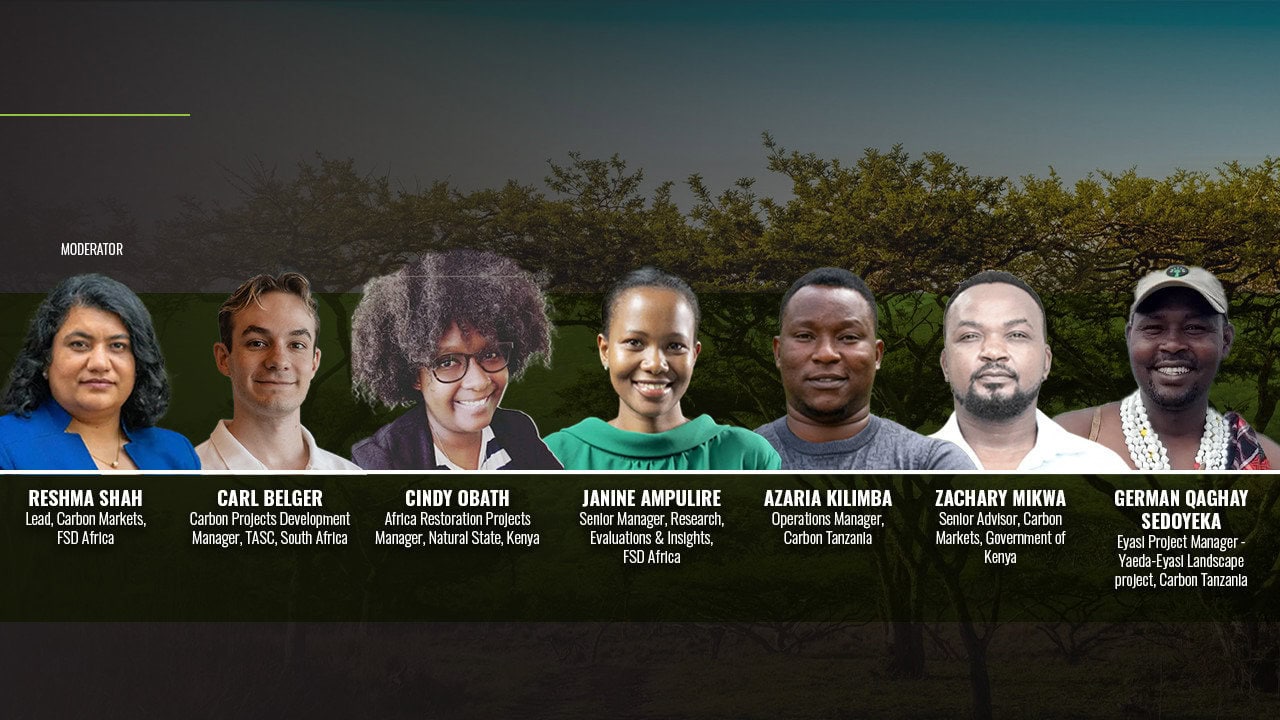
· Carbon Tanzania shared how projects are supporting education, land rights, and cultural identity through direct community financing.
· Successful projects empower communities, protect local rights, and build trust through benefit-sharing.
· Co-benefits must be measurable (e.g., SDG impact, biodiversity richness) and locally relevant.
· Nature-based carbon markets can fund long-term conservation if supported by:
o Strong data infrastructure
o Good governance at community and national levels
o Smart, context-specific project design
o Long-term investment and planning (5–10 years+)
· Projects must balance community needs with conservation goals for sustainability.
· Carbon markets provide a sustainable, market-based alternative to traditional donor-funded conservation, linking nature protection to the global economy.
· Carbon markets assign value to standing forests and wildlife, creating incentives to conserve rather than exploit.
· Effective measurement, reporting, and verification (MRV) systems are essential for transparency, trust, and market integrity.
· African countries need stronger regulations and institutions to support robust MRV systems.
· Successes in carbon markets should be highlighted to maintain momentum and confidence.
· Domestic carbon registries and African standards are being developed to enhance environmental and social integrity.
· Carbon markets can seem intangible and complex, causing skepticism; co-benefits like job creation help make projects more tangible and understandable.
· Success in delivering co-benefits depends on understanding local context, social systems, and community needs—not just fixed worldviews.
· Incentives like the Climate, Community, and Biodiversity (CCB) certification encourage developers to prioritize co-benefits by enabling higher credit prices.
· Governments need credible data on socioeconomic impacts to support incentives, policies, and benefit-sharing frameworks.
· Transparency, clear benefit-sharing (e.g., Tanzania’s 61% of carbon revenue to communities), and alignment with standards are crucial for project success and trust.
· African countries should unify their voice in international carbon market negotiations to protect their interests.
· The future of funding should look beyond carbon credits alone, elevating biodiversity, social, and economic benefits as standalone financial assets.
KEY TAKEAWAY:
· Community-centered project design, transparency, and long-term sustainability are essential for success.
 Contact Us
VUKA is the trusted media partner to key professionals, policy makers, suppliers and
manufacturers. We provide unparalleled opportunities for industry-wide connection.