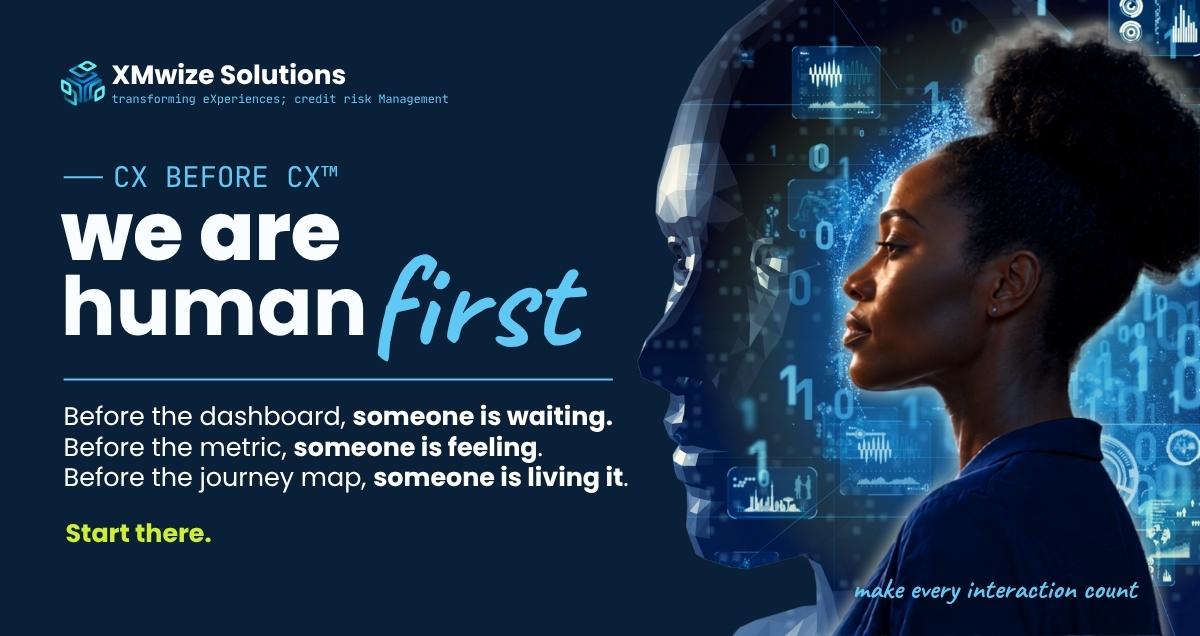
Before the dashboard, someone is waiting.
Before the metric, someone is feeling.
Before the journey map, someone is living it.
Start there.
Customer experience has become more sophisticated. We have better tools, better data, better platforms, better dashboards and better ways to map what customers go through. All of that matters. I believe deeply in the discipline of CX.
But sometimes, in making CX more professional, we risk making it feel less human.
Before there was customer experience, there was human experience. A person trying to be seen, heard, helped, guided or reassured. A person trying to solve something that matters to them, even if it looks small from inside the organisation.
A customer is rarely thinking about our framework. They may be anxious, irritated, hopeful, confused, embarrassed or simply tired. They may need clarity. They may need reassurance. They may need someone to take ownership.
Long before that customer feels the experience, the organisation has already shaped it. A leader has decided what matters. A process has made something easier or harder. A system has created a limitation. A metric has signalled a priority. An employee has been given confidence or left to work it out alone.
This is what I call the CX before CX™. The experience behind the experience. The human and organisational conditions that shape what customers eventually feel.
Customers do not only experience the person in front of them. They experience what that person is working inside.
They feel the policy. They feel the pressure. They feel the target. They feel the handover between teams. They feel whether the employee has permission to use judgement. They feel whether the organisation has made it easy to do the right thing.
That is why customer experience cannot sit only at the frontline. The frontline often reveals the experience, but it does not create it alone.
In my own work, especially in financial services, credit, collections and recovery environments, I have seen how quickly the truth shows up when people are under pressure. It is easy to speak about care when the customer is happy and the process is working. The real test comes when something has gone wrong, when the conversation is difficult, when the customer is vulnerable, or when the employee has to choose between the script and the human being in front of them.
That is where CX becomes real.
Human first does not mean soft. It also does not mean ignoring commercial realities.
Human first means understanding that people make the decisions that shape performance. Leaders, employees, partners and customers are all making decisions inside the environment the organisation has created.
If that environment is unclear, people become cautious. If it is too rigid, people stop thinking. If it rewards speed but talks about care, people learn what really counts. If it measures activity but misses meaning, the customer feels the gap.
Human first asks a practical question: are we helping people make better decisions in the moments that matter?
That takes more than good intent. It takes clear leadership, practical tools, usable data, meaningful measures and enough trust for people to act with judgement.
The best customer experiences are rarely created by chance. They are designed into the way people work.
Technology is changing customer experience at speed. AI, automation and digital platforms can improve access, reduce effort, personalise service and help organisations respond faster. Used well, they can remove unnecessary friction and give people more space to focus on the moments that need care.
But technology does not carry trust on its own.
Trust is built when the experience feels joined up. When the digital promise matches the human response. When the data is right. When the handover works. When someone takes ownership. When the customer does not feel abandoned between channels.
The next stage of CX will depend on how well organisations design technology and humanity to work together. Technology should strengthen human judgement. Human judgement should protect the relationship.
Every customer experience has an employee experience behind it.
If we want customers to feel respected, employees need to understand what respect looks like in action. If we want customers to feel reassured, employees need enough confidence to guide them. If we want customers to trust the organisation, employees need to trust the environment they are working in.
Training cannot only be about knowledge. People need to practise the moments that matter. They need shared language. They need to understand the customer’s world. They need leaders who reinforce the right behaviour when it is inconvenient, not only when it is easy.
The question is not only whether our people understand CX. The better question is whether they can act differently when it matters.
The customer experience conversation often starts with the frontline, but the roots sit higher.
Leaders shape what gets funded, what gets measured, what gets rewarded, what gets fixed and what gets tolerated. They shape whether people feel safe to raise problems, challenge poor processes and use judgement.
Human-first leadership asks honest questions:
The strongest organisations do both. They understand that trust and performance are connected. When experiences are designed with intention, alignment improves, risk reduces, efficiency sharpens and loyalty strengthens.
The future of customer experience will require more than better tools. It will require better interpretation.
Between what leadership decides and what customers experience sits human judgement. That is where strategy becomes behaviour. That is where culture becomes visible. That is where loyalty is built or weakened.
Human first is the CX before CX™.
It is a reminder that every process teaches a behaviour, every metric signals a priority, every system shapes a feeling and every interaction leaves an imprint.
When organisations start with the human being, the experience becomes more honest, more useful and more meaningful.
And in the end, that is the work.
To build trust.
To create clarity.
To protect dignity.
To help people act.
To make every interaction count.

 Contact Us
VUKA is the trusted media partner to key professionals, policy makers, suppliers and
manufacturers. We provide unparalleled opportunities for industry-wide connection.