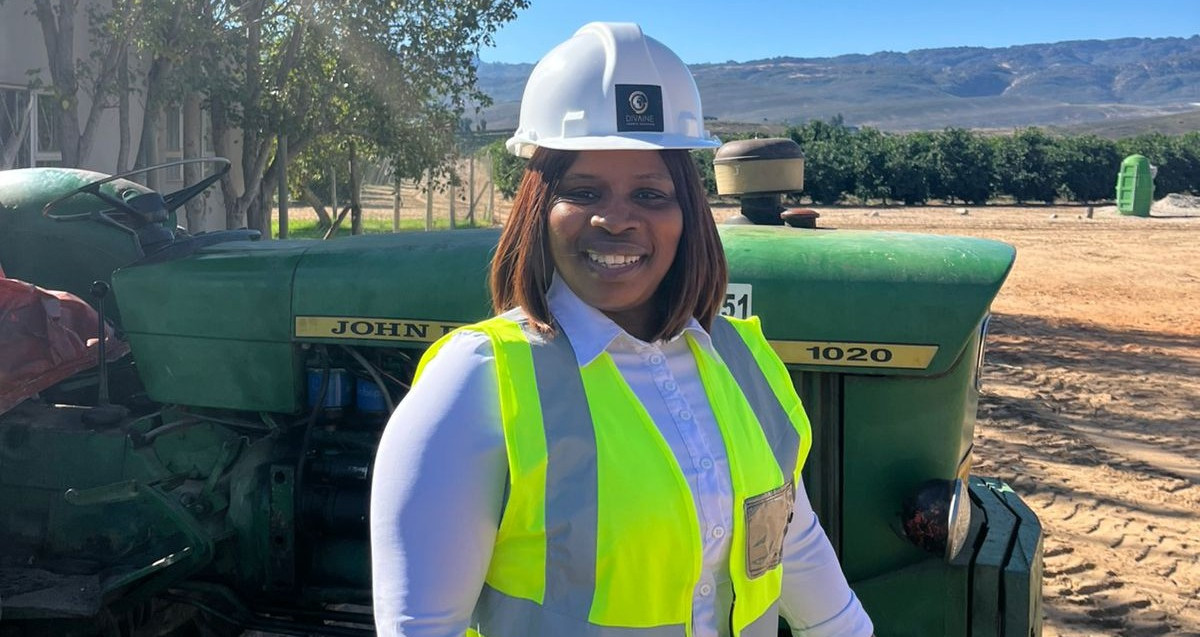
Yolanda Mabuto.
Yolanda Mabuto, founder of Divaine Growth Solutions, leads a renewable energy company focused on Africa’s energy transition.
With two decades of experience, including at Eskom, Mabuto champions business to business solar, battery storage, emobility and integrated energy solutions.
Divaine partners with local and international organisations, including a major car rental global company, to deliver sustainable energy projects across South Africa.
The firm is piloting electric buses with Johannesburg and advocates for cleaner transport, job creation and skills development.
Mabuto emphasises collaboration with government, municipalities and SMEs, highlighting the South African Renewable Energy Master Plan.
As a female-owned enterprise, Divaine promotes women and youth inclusion, supporting female entrepreneurs through partnerships and market access. Mabuto insists women must be architects of the green economy, creating opportunities for future generations.
She urges women to empower themselves, show up, and lead with zeal, ensuring Africa’s clean transition fosters inclusion, entrepreneurship and shared prosperity.
Hi, everyone. My name is Yolanda Mabuto. Thank you so much for having me. Well, when I have to speak about my background, I get so excited because it has been quite a journey.
I am the founder and the managing director of Divaine Growth Solutions, which is a renewable energy company across Southern Africa, and of course, with the vision to light up Africa.
We are an energy transition company. I spent almost two decades working across energy. I worked for Eskom for almost a decade and quite a number of international energy organisations.
And that is where I established my leadership within the energy sector, including being the founder and the managing director of Divaine, where we’ve established practical solutions that are really an answer to the challenges that we are facing as South Africa as well as Africa at large.
As an organisation, we address challenges for organisations because we really understand it’s important for organisations to thrive and be profitable and also be able to address economic and environmental challenges.
They have to get access to energy, but they also have to get energy that is sustainable. And that is where Divaine comes in to support energy solutions, help organisations to transition.
Our work includes solar PV, the battery and energy storage, as well as inverters. We believe in energy management and in emobility solutions. We’re quite excited to be helping organisations transition.
And we work with local organisations as well as international organisations where we really combine our energy experience and expertise but also including the digital aspect in it, because technology is always advancing and we always have to stay ahead of what is coming into the market and coming in for business.
Our broader work includes serving as Secretary General for BRICS Energy and Green Economy. The company is a member, but as a leader, I am the SG for the BRICS Energy and Green Economy where I contribute through conversations around how we can support Africa’s transition.
But also focusing in South Africa as the first country that can take this across the entire Africa to ensure that the green economy, the energy transition, and really the climate focus is attended to. So for me, green economy is not only about technology. It’s also about economic opportunities, job creation and so much more.

WEBINAR: Africa’s climate action – who is actually delivering?
We are excited when we deal with our clients and the projects that they bring to us, we get so excited because they are the solution to the challenges that we are seeing in the sector.
And one of the projects that we’ve worked with particularly, is working with some of the international car rental organisations, automotive industries, but more particularly the manufacturing sector where we understand that energy is a must.
They cannot afford to be without power through outages or any technical faults that the grid might have.
One of the biggest project that we’ve worked with currently, I won’t mention the name, but it’s one of the biggest car rental companies in the world.
And we are helping them to transition from the traditional way of consuming energy into an environmentally friendlier way of consuming energy.
And it’s been quite a journey to get to their transition and why they need to transition in this time. And we’ve worked with a number of companies as well who have a national footprint.
And this project is not only focusing on one province, it’s focusing on multiple provinces in South Africa, which again gives us a very good national footprint while working with a global organisation.
This has taught us a lot about the importance of transitioning organisations within the green economy sector. And it’s not simply about installing solar panels. It involves understanding each and every site, what is the profile, what are the operational requirements, but also how do we support them to monitor and to maintain the assets that they’ve acquired?
Because it’s important that every client understands the investment that they are making and what type of impact it has for them and on the environment that they operate in. We’re also involved in emobility, which makes us excited because emobility is still quite new in South Africa.
So as a female-owned organisation, currently we have an MOU with the City of Johannesburg where we are going to be doing a pilot for mass transit for their buses. It’s important that as we transition we don’t leave people behind.
So for us, mass transport is important because that’s where you get the public opinion and also give them the experience of how it is to ride in an electric bus or in electric cars so that they can then make informed decisions as and when they decide to buy their own electric cars or electric buses.
So we’re excited about this. We also want to make sure that we’ve got wider reach in South Africa, not just in Johannesburg. It’s an opportunity also to make sure that we make our cities smart, we make our cities green while we are greening the industry.
Cleaner transportation, cleaner energy is key as we move in transition as the nation as well as the continent. Creating opportunities is one of the things that drives us to be involved in such initiatives and projects as well as skills development.
We are currently facing a high unemployment rate in South Africa. So these initiatives are allowing us to be able to be an enabler of jobs for young people as well as women. Our wider vision in this space is to help organisations and government to move from simply buying renewable energy equipment or just to developing integrated energy transition solutions.
It’s important that we take them through the journey and there has to be understanding. And I know in our country right now, we talk about the infrastructure for electric cars or electric buses.
We are also in that space. It’s part of the value chain because we understand it’s important that we build sustainable and strong infrastructure for us to transition into cleaner ways of transporting our people.
So South Africa right now is entering an important phase. And therefore, as we transition, we need to ensure that we grow investments.
We understand the technologies that we have as a country in terms of solar, wind, battery storage, as well as green hydrogen is something that is very topical now. So it’s important for us to partner with organisations while we help them to transition within our projects.

Partnerships for us are key. As Divaine Growth Solutions, one of our strongest pillars is collaboration.
And we are intentional about collaborating because we understand that as a company, we can never do everything that we do on our own. We need government to endorse the work that we do.
We need government so that we can understand how can we support them in implementing policies. And one of the things we did when we were starting the organisation about a decade ago, was involve the department at the time and we told them this is our strategy, and this is how we would want to work with them.
And they were quite welcoming and they endorsed the programmes that we had at the time. And for us, that was a true testament to the importance of partnerships as we grow our economies and grow our industries. No single organisation can solve Africa’s energy challenges alone.
So for us, we are intentional as we transition, we require collaboration. We require collaboration with government, with municipalities, and we’re happy that we are also part of the Association of Municipal Electricity Utility (AMEU).
We sit on the executive committee for affiliates; again, to make sure that our voices are heard. And we always represent the voice of women and young people in the spaces that we partner with.
So, collaboration is key for cooperation and advancement, for finance and investment, also for developing institutions around SMEs, because we are also in the range of SMEs.
So for an SME like ourselves, Divaine Growth Solutions, partnerships allow us to bring together capabilities that sometimes we might not have as an organisation.
I also believe that partnerships go beyond just simply signing MOUs. They must translate into projects and investments.
They must also translate into skills development, but also market access to make sure that we’ve got an impact that is measurable within our sector and within the nation that we operate in.
We know that right now in South Africa, we have to ensure that energy transition develops not only in South Africa, but in Africa at large.
So for us, it’s important to partner with not only companies from abroad, but within African organisations so that we build African businesses and skills together, and also create value chains within Africa rather than simply importing technology from outside Africa.
So that is why for us, collaboration is key.
The South African Renewable Energy Master Plan also is very clear around the links in renewable energy growth and how important it is to partner and collaborate for industrial development of the sector, but also to localise the work that we do across the suppliers, emerging suppliers within South Africa and Africa at large.
When we started our organisation, because at the time it was very male-dominated, one of the things that we looked at, being a female-owned organisation, was the female enterprise development, because we saw the need.
We saw the need that women need to be empowered, particularly women in the business sector. They needed access to the right information so that they can make the right decision.
They needed access to market so that their products, services or solutions can be taken to the market. They needed access to the right partners so that their businesses can grow and thereafter grow economies within South Africa.
So yes, as a women-owned organisation, we believe that we need to empower women and youth. So youth inclusion is also equally important as we transition and as we grow.
So what we have done is to create opportunities for women not only to participate in the energy sector but to own businesses. And we do this with a number of organisations that we are part of.
One of those is the Lean in Southern Africa Leaders, which again encourages women to form businesses and form partnerships and be able to position themselves for solutions and opportunities within Africa as well as the world.
So for us, our approach includes creating opportunities that will allow women to extra income streams, to create better partnerships that will help them to sustain, not only to sign MOUs and NTAs that won’t go far.
But to have opportunities to create projects, impact projects that will add value to the lives of young people, that will add value to their families and their communities.
So it is critical that we as a women-owned business support businesses that are also owned by women but also young people who are seeing quite a rise of young people that are opening up businesses.
And our role as a company is to work alongside those organisations and to understand which doors we can unlock for them so that they can, number one, grow, number two, have information that will empower them to change the issues and the challenges that they are seeing in the spaces in which they operate.
So really, I believe that we need to look beyond employment. We need women-owned businesses to have access to suppliers, big organisations that can take in women-owned companies and allow them to be their subcontractors and service providers.
In that way, we will see empowerment of women in South Africa. And this is increasingly being recognised as a competitive issue in our country.
So it’s not only about a gender issue, it is also about making sure that as we transition in the green economy, we do not leave anyone behind, be it women or be it young people.

I believe that as a country, we have made quite a journey in celebrating women but also in empowering women. And that journey that the country has been on, it is to be acknowledged. We understand August is the month where we celebrate women.
And this should be something that we do on a daily basis. Because for me, Women’s Month should not only be about celebrating women. It is about everything that is practical that we have seen.
And the question really is, are we actually participating in the economic opportunities that are being created in green transition?
And that’s a question that we always ask ourselves as an organisation and as leaders, are we getting more contracts for women? Are we allowing women to have access to finance?
And it’s very similar to what I’ve just spoken about, about creating opportunities. Are we helping supporting women to own renewable energy businesses?
Again as I said earlier, when we talk about women empowerment and women’s celebration, celebration should not be a monthly thing or a one month thing or a one day thing. It should be a continuous, sustainable impact that is seen socially, economically, as well as environmentally.
So as South Africa celebrates Women’s Month in this year, I strongly believe that we have seen quite a number of achievements and some traction in the country.
But there’s more to be done. And I’m speaking on behalf of myself as a leader in the country, on the continent, and in the world.
There’s a lot to be done for young people so that they don’t have to work hard, the way that we have worked hard, the way that women that came before me have worked hard.
We have to create ecosystems that will support women so that it doesn’t have to be a monthly celebration. It’s an everyday thing because women have gotten to the path of being part of economic growth.
They have gotten to the path of not being sidelined, but also being included in the ecosystem of economic growth. They need to have their voices heard in the boardrooms, in government, as well as in smaller ecosystems, in education; women should be heard everywhere.
So for me, like I said, it’s important that we don’t say we celebrate women only this month. It should be part of how we live life. And I believe women must move from just being beneficiaries of the green economy, but more about being architects of the green economy.
I know they have capability, they have capacity. I know there’s energy, zeal and passion. So as leaders, we should be able to say, how do we make this happen?
How do we create pathways for such things to happen? It means creating access to capital. It means creating access to procurement. It means creating technologies, mentorship, and also access to market.
So as we celebrate women in South Africa, I believe women entrepreneurs have the responsibility to also create opportunities for the next generation.
And as we continue to build Divaine Growth Solutions successfully, we want to ensure that our impact is felt, it is seen, and it is leaving a legacy that will be seen even by those that have not yet been born to this day.
So it’s important for us to not only talk about celebration of women, but also saying Africa’s clean transition is one of the greatest economic opportunities for our generations. And women should be strategic in those spaces.
Their voices should be heard, but we must also make sure that it is not only a transition to cleaner energy, it is also a transition to greater inclusion, entrepreneurship, local value creation as well as shared prosperity.
For me, as I grow in the business sector, I understand it’s important for women, number one, to empower themselves and not to wait for things to be given to them. They should go out there.
They should be able to have a voice. They should know how they can add value in the ecosystems that they’re part of. It is important that we don’t always say we are underdeveloped but the opportunities are there for us to take.
I always encourage women to show up, because showing up is a sign of saying, I’m ready. One of the things that I’ve done in my years of building myself as a leader is to serve, is to always raise my hand.
In raising your hand, you’re able to serve so that when you then have the leadership position you understand how serving is. And you can also appreciate those who will be serving under you.
So one of the thoughts that I will share with women and men today is that we must always run the race with zeal and passion. We must always be ready to serve. We must always be eager to know the challenges that we can provide solutions to.
WEBINAR: Article 6.2 of Paris Agreement – what African carbon project developers need to know
 Contact Us
VUKA is the trusted media partner to key professionals, policy makers, suppliers and
manufacturers. We provide unparalleled opportunities for industry-wide connection.