
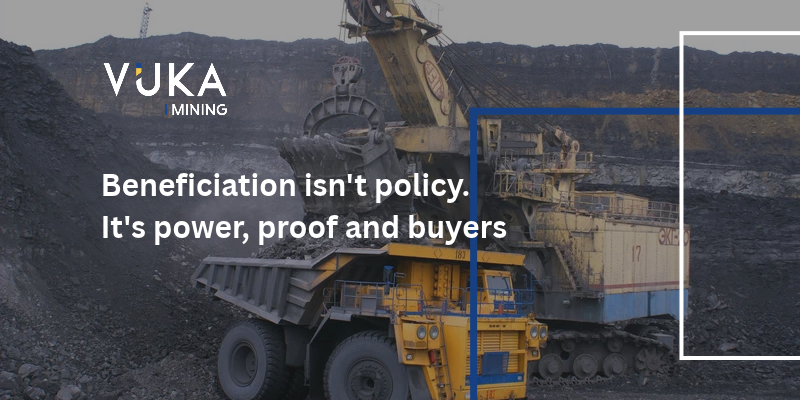
Beneficiation is usually framed as a policy question: how a country captures more value from its minerals before export.
For the operator sitting on the resource, the question looks different. It is not “should we process locally” but “what has to be true for processing to make commercial sense.”
Four things tend to determine the answer.
Concentration, smelting, and refining are energy-intensive steps, and the economics of ferrochrome, PGM matte, or lithium hydroxide production are set as much by power price and reliability as by ore grade.
A plant designed against unreliable or unbudgeted power is a plant that underperforms from commissioning. This is why infrastructure conversations sit next to beneficiation conversations rather than behind them.
ALSO READ: What a bankable Zimbabwean mining project looks like in 2026 – 7-point checklist
A mine can often be financed and de-risked in stages, ramping production as cash flow allows. A processing facility is a large, front-loaded commitment that is far less divisible.
That changes the financing conversation: offtake-linked structures, strategic partner equity, and blended finance tend to carry more weight than they would in extraction-only projects, because lenders want to see the downstream market secured before they fund the plant.
Ore variability across a deposit can undermine a flowsheet that looks sound on paper. Pilot-scale test work, and a willingness to revise recovery assumptions once real ore is run through the process, sits ahead of any beneficiation commitment.
Skipping this step is a common source of stalled or underperforming plants.
Local processing only adds value if there is a buyer willing to pay for the upgrade, a refined or semi-refined product priced against a market that recognises the difference.
Without that buyer secured, beneficiation shifts cost forward without shifting revenue, which is the opposite of the intended outcome.

Put together, these are not abstract constraints.
They are the checklist an operator works through before beneficiation moves from strategy slide to capital decision: power secured, financing structured against the offtake, metallurgy proven at scale, and a buyer committed to the upgraded product.
Where all four align, local processing becomes a bankable proposition rather than a policy aspiration.
This is the level at which Zimbabwe Mining Week’s beneficiation track is built to operate, moving the conversation from potential to the operational sequencing that determines whether a project actually gets built.
📅Join us at Zimbabwe Mining Week, 17–19 November 2026, Rainbow Towers, Harare
READ NEXT: Zimbabwe’s critical minerals moment and what it will take to hold it

 Contact Us
VUKA is the trusted media partner to key professionals, policy makers, suppliers and
manufacturers. We provide unparalleled opportunities for industry-wide connection.
